



Inbound Logo
Web Development
Resources
Free audit
Free HubSpot Portal Audit
Get an instant audit of your HubSpot portal with actionable insights to improve CRM setup, automation, marketing, and overall performance.
Start Free Audit
button arrowbutton arrow
Webflow

Webflow Development: The Complete 2026 Guide for Businesses

time
12 MIN
date
April 24, 2026
Webflow Development: The Complete 2026 Guide for Businesses
In this article

Webflow used to be the platform designers recommended when they didn't want to touch WordPress. That's no longer the whole story. In 2026, serious SaaS companies, growth-stage B2B brands, and agencies on both sides of the Atlantic are building their entire marketing stack on Webflow — and the ones that aren't are losing ground on speed, SEO, and iteration velocity.This guide is written for business owners, marketing leaders, and founders evaluating Webflow development as a serious option. No hype, no feature dumps. Just what you actually need to make a decision: what Webflow is good at, where it breaks, what it costs, how long a project takes, and when you should hire a specialist Webflow agency versus a generalist.

What is Webflow Development

Webflow is a visual development platform. That means designers and developers build pixel-precise websites in a browser, and Webflow generates clean, semantic HTML, CSS, and JavaScript — the same kind of output a senior frontend developer would hand-code, minus the months of work.Webflow development is the practice of using that platform professionally: building marketing sites, SaaS websites, landing pages, and content-heavy blogs with production-grade code, real CMS architecture, and serious integrations. It's not drag-and-drop templates. It's custom engineering with a visual interface.A quick reality check. Webflow sits between three worlds:

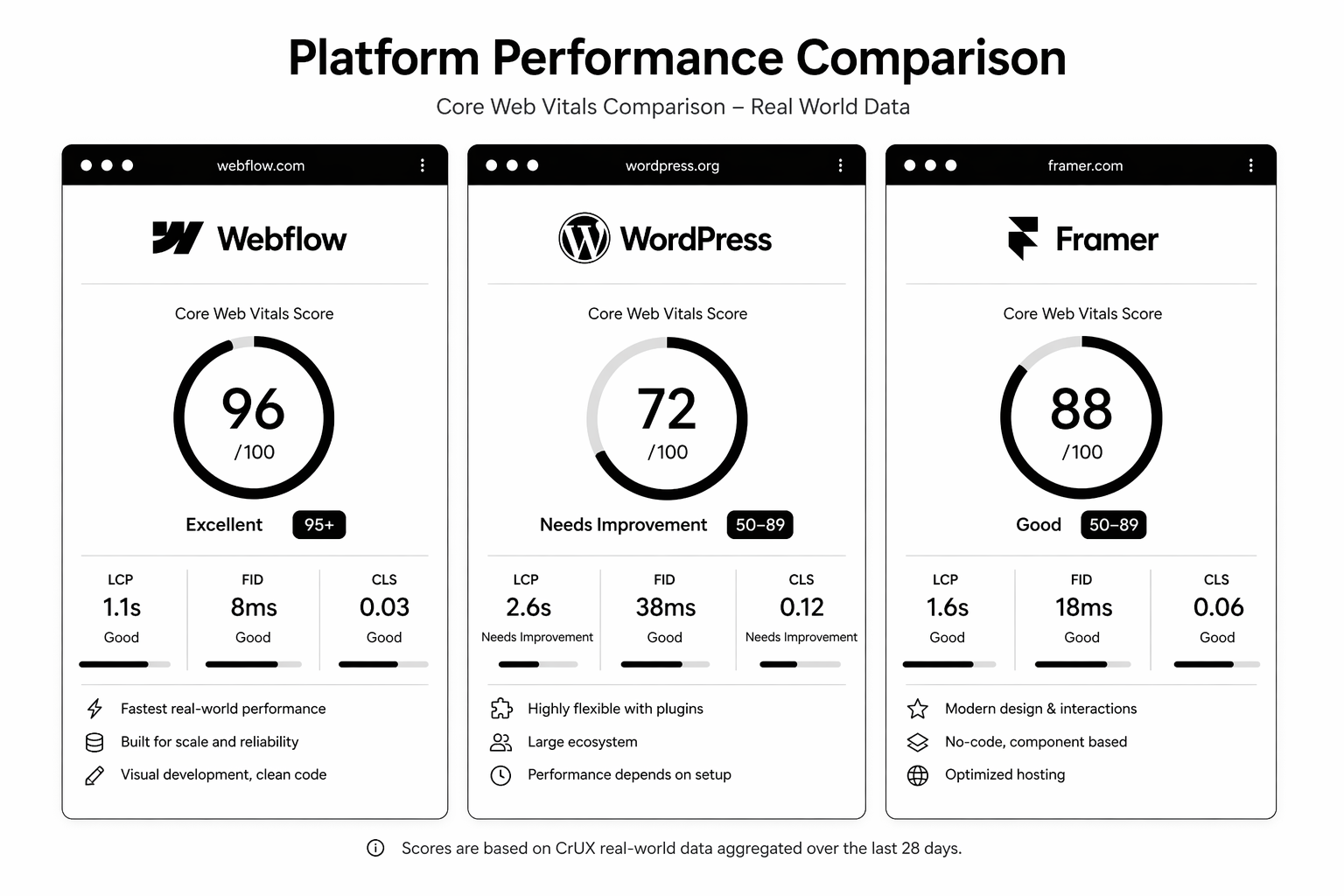
  • WordPress: more extensible, much slower, maintenance-heavy.
  • Framer: faster to design, less mature for content scale.
  • Custom React/Next.js builds: more flexible, 5–10x the cost, slower to iterate.

Webflow's sweet spot is marketing sites with up to ~2,000 CMS items, heavy content velocity, and a team that wants to ship changes without a developer in the loop.

Why Webflow Matters in 2026

Three shifts pushed Webflow from "nice tool" to "default choice" for a specific kind of business.1. Core Web Vitals became a revenue issue. Google now treats page experience as a confirmed ranking signal, and the 2025 interaction-to-next-paint (INP) update punished bloated WordPress themes hard. Webflow sites routinely hit 90+ Lighthouse scores without heroics.2. Marketing teams want control. The average marketing leader is sick of filing tickets to update hero copy. Webflow's Editor lets non-technical staff ship changes without breaking the site — and without the security debt that comes from giving ten people access to a WordPress admin.3. Design consistency is a hiring moat. Webflow's class system enforces a design system by default. That means the fifth landing page you build doesn't drift from the first. For agencies and growth teams shipping 20+ pages a quarter, that compounding consistency is real money saved.If you want the full comparison with the incumbent, read our breakdown of Webflow vs WordPress. If you're weighing it against Framer, see Framer vs Webflow.

How Webflow Development Works

A professional Webflow build has five layers. Understanding them prevents you from getting oversold on a "pretty template" build and undersold on what you actually need.1. Style SystemThe foundation. Variables for colour, type scale, spacing, and breakpoints. Component classes built with a naming convention like Client-First or MAST. This is what makes a Webflow site maintainable at 50+ pages.2. CMS ArchitectureCollections, reference fields, multi-reference fields, and dynamic pages. A well-designed CMS handles blogs, case studies, team profiles, job listings, changelog, and resource libraries — all without duplication.3. Interactions & AnimationWebflow's native interactions handle scroll-linked animation, hover states, and timeline sequences without third-party scripts. For more advanced motion, GSAP integrates cleanly.4. IntegrationsThe modern Webflow site is wired to HubSpot, Segment, Clearbit, Intercom, Calendly, and payment tools. Native forms post to your CRM, not a mailbox nobody checks.5. SEO & Performance FoundationProper heading hierarchy, schema markup, image optimisation via CDN, and 301 redirect maps. This is where most cheap Webflow builds fail — designers build beautiful sites with zero SEO architecture.

Step-by-Step Guide: How a Serious

Webflow Build Runs

Here's the project timeline a specialist Webflow agency runs for a ~30-page marketing site.
Webflow Build Runs

Week 1 — Discovery. Strategy workshop. ICP, positioning, competitor teardown, information architecture, keyword map. Output: sitemap + wireframes.Weeks 2–3 — Design. Figma design of key templates (home, solutions, pricing, blog, case study, legal). Design system finalised. Output: approved high-fidelity designs.Weeks 4–6 — Development. Webflow build begins. Style system first, then templates, then CMS collections, then integrations. Staging site delivered mid-week 6.Week 7 — QA & SEO. Cross-browser testing, Core Web Vitals tuning, schema implementation, 301 redirect map, search console setup.Week 8 — Launch & Enablement. DNS cutover, post-launch monitoring, training sessions for the marketing team, documentation handoff.Timelines shift with scope. A startup marketing site can ship in 4 weeks. A migration from WordPress with 500+ URLs takes 10–14. Anyone quoting you "2 weeks for a custom Webflow site" is either using a template or cutting the SEO and integration work.

Thinking about a build this quarter? Our team runs Webflow builds for SaaS, agencies, and ecommerce brands across the UK and USA. Book a free 30-minute Webflow strategy call and we'll map the scope, timeline, and realistic budget for your project.

Best Tools and Platform Stack for Webflow in 2026

A production Webflow site doesn't live alone. Here's what we install on almost every client project.

  • Finsweet Attributes — CMS filtering, load more, mirror CMS. Extends Webflow's native CMS without custom code.
  • GSAP — For motion that goes beyond Webflow's native interactions.
  • Jetboost or Wized — Dynamic CMS behaviour (favouriting, filtering, user-specific content).
  • Weglot — Localisation if you're serving UK, US, and EU markets.
  • Memberstack or Outseta — Gated content, member portals, low-lift SaaS auth.
  • HubSpot native integration — For form routing, lead scoring, and lifecycle tracking. If you're on HubSpot, our HubSpot development team can wire this cleanly.
  • Cloudflare — Layer in front of Webflow's CDN for enterprise-grade WAF and analytics.
  • Fathom or Plausible — Privacy-first analytics for UK/EU compliance.

For Webflow development cost planning, we go deeper in our Webflow development cost breakdown.

Common Mistakes in Webflow Development

These are the five we see most often when cleaning up other agencies' work.1. No naming convention. Every class is ad-hoc. Six months later, nobody on the team can ship a new page without breaking three existing ones. Fix: adopt Client-First from day one.2. CMS built backward. Collections created before information architecture is finalised. Result: reference fields that don't connect, content editors confused, migrations required. Fix: sitemap first, CMS second.3. No redirect map on migration. Team swaps DNS and 40% of organic traffic disappears inside two weeks. Fix: full URL inventory and 301 redirect map before launch. Our WordPress to Webflow migration guide walks through this.4. Images uploaded at 3,000px. Lighthouse scores tank, INP goes red, mobile bounce rate climbs. Fix: compress to 72ppi, serve in WebP, use Webflow's responsive srcset.5. No internal linking structure. Marketing blogs are published as orphans. SEO never compounds. Fix: editorial linking rules + pillar/cluster model.

FAQ

Is Webflow SEO-friendly?

Yes. Webflow gives you granular control over meta titles, descriptions, Open Graph tags, canonical URLs, and schema markup. Sitemap generation is automatic. Core Web Vitals scores out of the box are strong. The platform isn't the bottleneck — the build quality is.

How much does Webflow development cost in 2026?

A small marketing site runs £8–15k / $10–20k. A full SaaS marketing site with CMS, integrations, and advanced animation runs £25–60k / $30–75k. Enterprise migrations with redirect mapping and localisation run £60k+. See the full breakdown in our Webflow development cost post.

Can I migrate from WordPress to Webflow without losing SEO?

Yes, with a proper redirect strategy, preserved URL structure (where possible), and content parity. Traffic dips 2–6 weeks post-migration are normal; most sites recover and beat prior performance within 90 days.

Is Webflow good for ecommerce?

It's fine for low-SKU, high-margin DTC brands (under 100 products, no complex variants). For serious ecommerce — subscription, multi-currency, 500+ SKUs — we recommend Shopify development instead.

Do I need a Webflow agency, or can I use a freelancer?

Freelancer for a 5-page marketing site. Agency for anything involving CMS architecture, migrations, integrations, or a brand at growth stage where site downtime costs real money. The difference is process and accountability, not raw skill.

How long does a Webflow build take?

4–8 weeks for a marketing site. 8–14 weeks for a migration. 3–6 weeks for a landing page program. Timelines shrink when design is already done and expand when discovery is open-ended.

Conclusion: When Webflow Is the Right Call

Webflow wins when your site is a marketing asset, your team wants to ship without developer dependency, and performance matters to your SEO and conversion. It's the right call for most SaaS companies, agencies, and B2B brands under $100M ARR. It's the wrong call for heavy ecommerce, complex auth systems, or sites with millions of pages.If you're weighing this decision now, don't do it in a vacuum. Most bad platform choices get made by teams reading marketing pages instead of talking to someone who's shipped 50+ builds on the platform.We've built Webflow sites for YC-backed SaaS companies, Series B brands, and agencies across the UK and USA. If you want a second opinion before you commit, book a free Webflow strategy call — 30 minutes, no pitch, we'll tell you honestly whether Webflow is right for your project and what realistic scope and budget looks like.

The Webflow Project Scoping Template   — the same Notion template we use with new clients to map sitemap, CMS, integrations, and budget tiers.

KEEP BUILDING
title arrow

You've got the plan. Let's build it.

We turn the frameworks you just read into the flows, pages, and automation behind them — under your brand, always.

Keep reading

View all articles
button arrowbutton arrow
Webflow Memberships and Gated Content: Complete 2026 Setup Guide
Webflow

Webflow Memberships and Gated Content: Complete 2026 Setup Guide

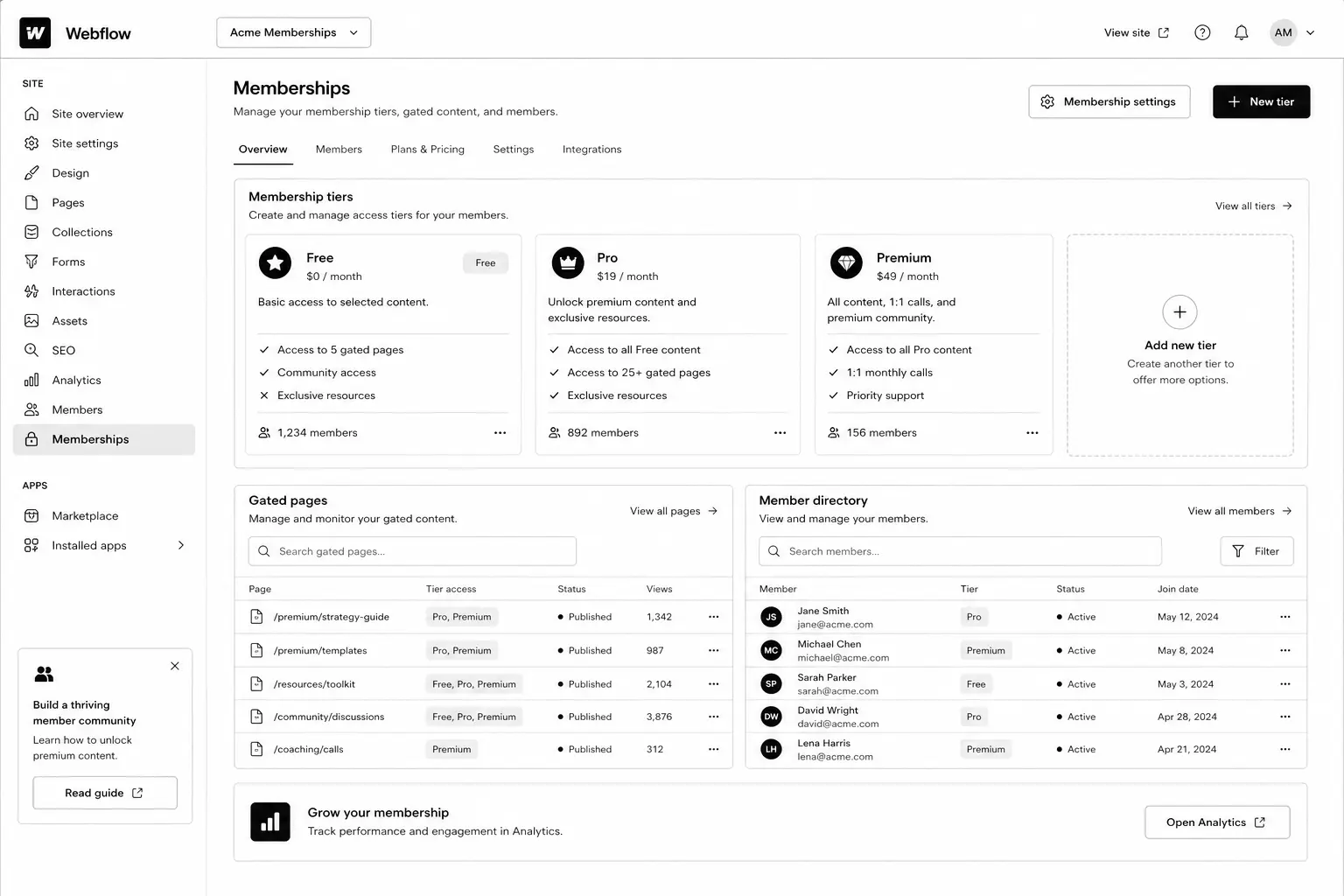
For years, the answer to "can I gate content on Webflow?" was "use Memberstack." It worked, but it added another tool, another bill, and another point of failure. Webflow Memberships changed that — and after two years of GA maturity, it's finally the right answer for most use cases in 2026.This Webflow membership site guide walks through the architecture, setup steps, gated-content patterns, and the trade-offs between native Webflow Memberships and Memberstack. By the end you'll know which one fits your project, how to wire it up, and how to scale to thousands of paying members without rebuilding.If you haven't built the underlying CMS yet, read the Webflow CMS tutorial first — Memberships is layered on top of CMS architecture, and a clean foundation matters.

What Are Webflow Memberships?

Webflow Memberships is a native module that lets you create user accounts, gate pages and CMS items, and integrate paid plans via Stripe. It handles sign-up, log-in, password reset, and access control without third-party tools.You configure access in three places: page settings (gate any page to logged-in users or paid plan members), CMS Collection settings (gate dynamic content), and the Designer (show / hide elements based on auth state).Released GA in 2023 and matured significantly through 2024–2025, the 2026 version supports paid plans, free plans, plan upgrades, and webhooks for integration with downstream tools.

Why Webflow Memberships Matters in 2026

Three reasons gated content became a serious play this year.1. AI killed ungated thin content. Free PDFs and ebook-bait lead magnets convert worse every quarter. Substantive gated resources (calculators, video courses, communities) still convert — and warrant a real membership system.2. The "free + paid tier" pattern is now standard for content businesses. Newsletters, courses, niche communities — most run a free tier (email gate) and a paid tier (Stripe-backed). Webflow Memberships handles both natively.3. Memberstack's pricing crept up. A 200-member site that cost $50/mo on Memberstack Lite in 2022 now runs $200+/mo. Native Webflow Memberships is included in CMS plans, no per-member fee.

How Webflow Memberships Works

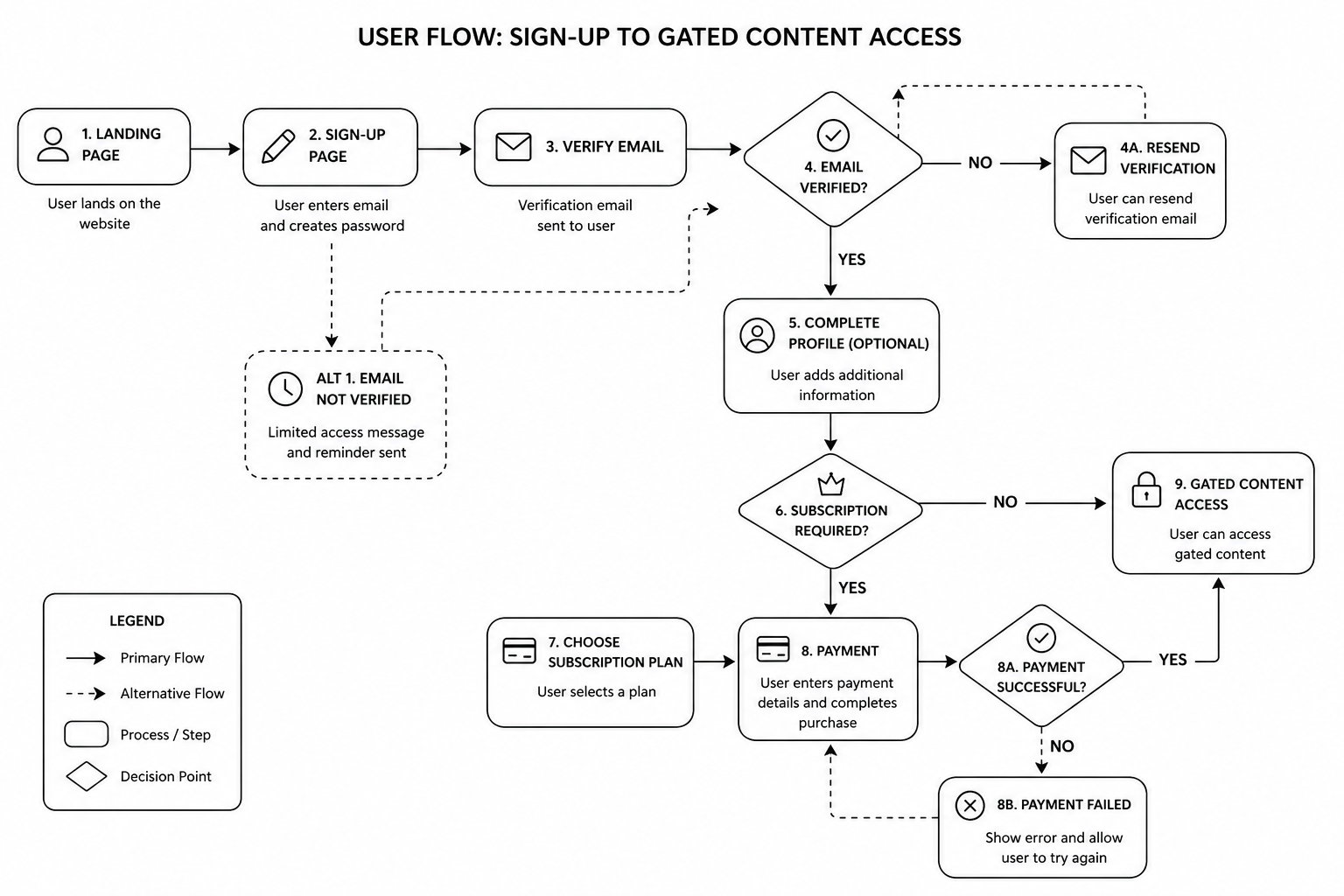
The mental model: pages and CMS items can be public, gated to "any logged-in user," or gated to specific paid plans. Users sign up, choose a plan (or stay free), pay via Stripe if needed, and the site dynamically gates content based on their auth state and plan membership.

The four building blocks

  • User Accounts — sign-up, log-in, profile, password reset
  • Plans — free, paid (one-time, monthly, yearly), with Stripe integration
  • Access Groups — collections of plans that can access specific content
  • Gated Pages and CMS — set per page or collection

Step-by-Step: Build a Webflow Membership Site

1. Plan your tier model first

Decide on the structure before opening Webflow. Common patterns:

  • Free + paid (most common). Email gate for free content, Stripe-backed paid tier for premium.
  • Free + Pro + Premium. Three tiers with progressive access.
  • Members-only community. Single paid tier, all content gated.
  • Course / cohort model. One-time payment for a fixed-length course access window.

2. Connect Stripe (for paid plans)

In Project Settings → Memberships → Payments, connect your Stripe account. Webflow uses Stripe Checkout for the payment flow — no PCI overhead. Set up Stripe Tax if you sell internationally.

3. Create plans

Add plans in the Memberships panel. For each plan, configure: name, price, billing cycle, trial (optional), and the access group.

4. Set up access groups

Access groups are collections of plans. Example: a "Premium Content" access group that includes both "Pro" and "Premium" plans. Then any page or CMS gated to that group is accessible to either plan.

5. Build sign-up, log-in, account, and password-reset pages

Webflow generates default versions; replace them with branded ones. Use the Memberships User Logged-In / Logged-Out states to conditionally show navigation, account menus, and CTAs.

6. Gate pages and CMS items

Per page: in page settings, set the access group. Per CMS: in collection settings, gate the entire collection or specific items via a reference field on each item.

7. Build the member dashboard

A dedicated logged-in homepage showing the user's name (via User Account binding), their plan, their resources, and a way to upgrade or manage billing (Stripe Customer Portal link).

8. Test the full flow end-to-end

  • Sign up free → access free content, gated correctly
  • Upgrade to paid → Stripe Checkout → return to dashboard with new access
  • Cancel paid → access reverts
  • Password reset email arrives correctly
  • Webhook fires to your CRM / email tool on plan changes

9. Wire up downstream integrations

Use Webflow Logic or third-party automations (Zapier, Make) to push new members into HubSpot, ConvertKit, or your CRM. See our marketing automation guide for patterns.Mid-article CTA → Want a specialist to architect your membership site so it scales? Book a free Webflow membership scoping call — we'll map your tier model and integrations in 45 minutes.

User Flow

Best Tools and Decisions: Native Webflow Memberships vs Memberstack

CapabilityWebflow MembershipsMemberstackNative Webflow integrationYes (built-in)Yes (via embed)PricingIncluded in CMS plans$50–500/moStripe integrationYesYesFree tierYesYesCustom user fieldsLimitedExtensiveWebhooks / APIWebhooks yes, API limitedFull APICustom auth flowsLimitedHighly customisableBest forStandard membership and gated contentSaaS-grade auth and complex flowsNative Webflow Memberships is the right answer for ~80% of projects. Use Memberstack when you need custom user metadata, advanced API integrations, or SaaS-grade auth flows that exceed native capabilities.

Common Webflow Memberships Mistakes

  • Gating too much, too early. If your free tier is thin, no one converts to paid. The paid offer needs to look obviously valuable from the free experience.
  • Forgetting password-reset and email styling. Default Webflow emails look unbranded. Customise them in Project Settings.
  • Not setting up Stripe Customer Portal. Members need a self-service way to manage billing, update cards, cancel. Stripe's Customer Portal handles it — link from the member dashboard.
  • Skipping webhook integration. If new paid members don't auto-flow into your CRM, your retention and engagement automation is dead on arrival.
  • Hard-coding access in custom code instead of using Access Groups. Brittle and unmaintainable.
  • Ignoring SEO on gated content. Decide whether each gated piece should be indexed (with a paywall metadata signal) or noindexed.

FAQ — Webflow Memberships

How much does Webflow Memberships cost?

It's included in CMS, Business, and Enterprise plans at no per-member fee. Stripe takes its standard processing fee on paid plans. No additional monthly subscription beyond your Webflow site plan.

How many members can a Webflow site handle?

The current cap is 10,000 members on Business plans, higher on Enterprise. Plenty of headroom for most B2B membership sites.

Can I migrate from Memberstack to Webflow Memberships?

Yes. Export users from Memberstack, import into Webflow via the Members API. Plan password resets — passwords don't carry across platforms.

Does Webflow Memberships support social log-in (Google, etc.)?

Not natively as of 2026. If social log-in is critical, Memberstack remains the better choice.

Can I run subscription billing through Webflow Memberships?

Yes — monthly and yearly plans via Stripe. For more complex subscription logic (proration, dunning, multiple subscription items), Stripe handles the billing logic.

Can gated content rank on Google?

Yes, with proper schema. Use the `isAccessibleForFree: false` flag in Article schema and serve the first paragraph or two to crawlers via Webflow's preview rules. Google supports this pattern formally.

Conclusion: Memberships Is Now the Default, Not the Workaround

If you're starting a new membership site or community in 2026, default to Webflow Memberships. The native integration, included pricing, and matured feature set make it the right call for the vast majority of projects. Memberstack is still the answer for SaaS-grade auth flows and deep API customisation — but those use cases are narrower than they used to be.Our Webflow agency has shipped membership sites for SaaS resource libraries, course businesses, and gated communities across the UK and USA. Book a free membership site scoping call and we'll map your tier model, integrations, and timeline in 45 minutes.Download the Membership Site Architecture Brief — the tier-model template and integration map we use on production builds.

Webflow Memberships & Gated Content Toolkit — membership strategy planner, CMS architecture template, access control framework, member journey map, gated content checklist, integration planner, launch QA checklist, and growth dashboard to build a scalable Webflow membership platform.

Webflow Ecommerce vs Shopify: Honest 2026 Comparison
Webflow

Webflow Ecommerce vs Shopify: Honest 2026 Comparison

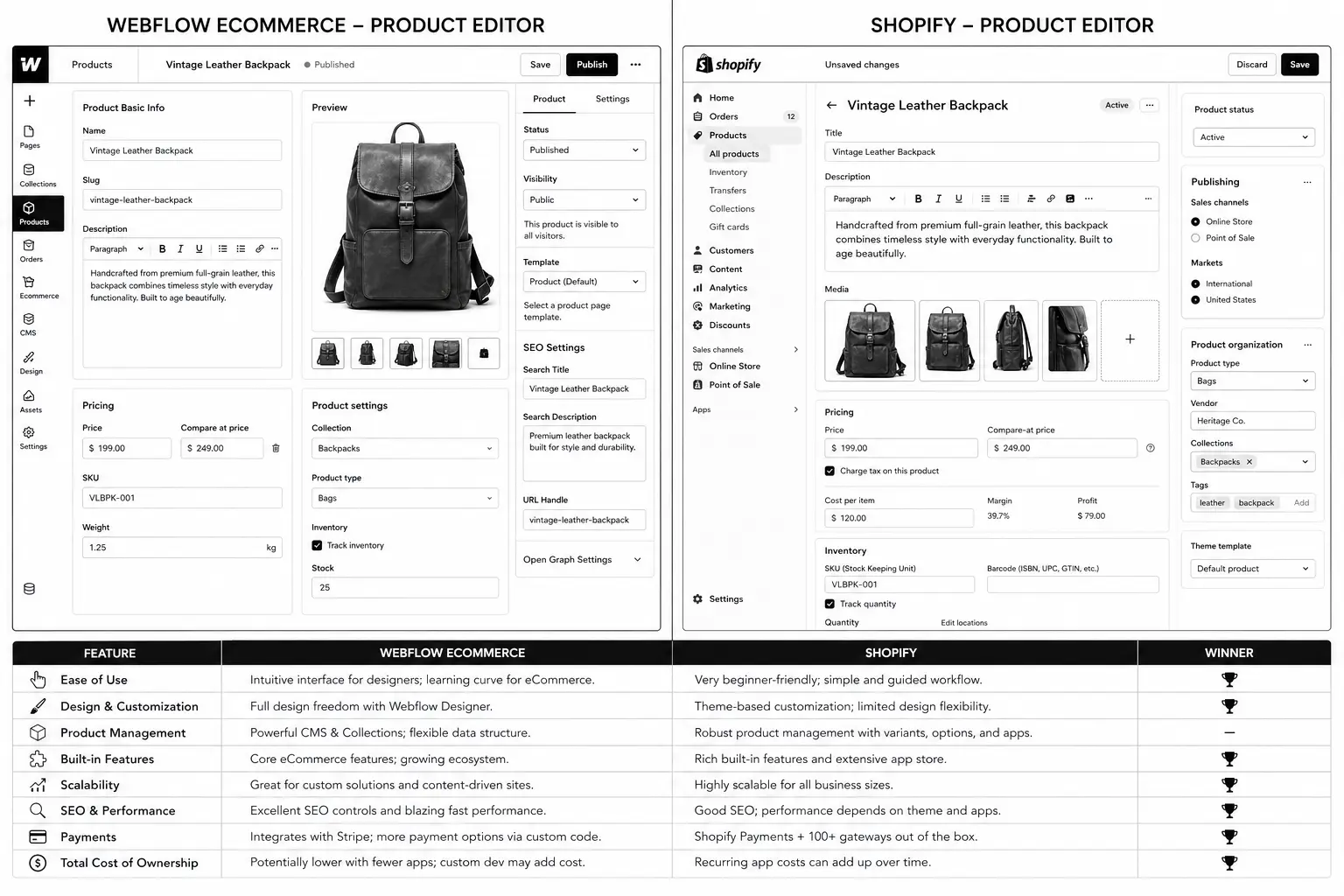
The Webflow vs Shopify question gets framed as a fight. It isn't. The two platforms barely overlap on customer profile in 2026 — they just occasionally chase the same SMB lead. The real question for founders and ecommerce leaders is: which one fits the brand you're actually building?This Webflow Ecommerce vs Shopify comparison is the honest 2026 breakdown — features, pricing, performance, scalability, and the brand profile each platform serves best. No fence-sitting. By the end you'll know which one to choose, and why our Webflow agency and Shopify development teams routinely recommend the other one when the fit is wrong.If you want a broader platform decision, also see the Shopify vs WooCommerce vs BigCommerce comparison.

What Each Platform Actually Is

Shopify is a purpose-built ecommerce platform — store, checkout, payments, inventory, shipping, taxes, apps, fulfilment partners — at every scale from $0 to $1B+ GMV. It's vertically integrated for selling.Webflow Ecommerce is the ecommerce module bolted onto Webflow's design-first CMS. It's a way for design-led brands to run a small-to-mid commerce operation inside the same site that handles their marketing content.That difference shapes everything else. Shopify is a commerce platform with marketing features. Webflow is a marketing platform with commerce features.

Why the 2026 Comparison Looks Different from 2022

Three things shifted recently.1. Shopify's checkout extensibility is now real. The 2025 Checkout Extensibility GA closed the customisation gap that pushed brands toward custom builds. See our Shopify checkout extensibility guide.2. Webflow Ecommerce hasn't kept pace. Multi-currency, advanced subscription models, and serious B2B features remained light. Webflow continues investing in CMS and Logic, not in ecommerce parity.3. The "design-led DTC" niche stayed loyal to Webflow. Brands selling 20–200 SKUs where the site itself is part of the product experience continue choosing Webflow Ecommerce because Shopify's design constraints feel limiting.

How They Compare on the Decisions That Matter

Pricing (2026 rates, GBP and USD)

TierWebflow EcommerceShopifyEntry$29/mo USD (~£23/mo) – Standard plan, up to 500 items$39/mo USD (~£25/mo) – Basic ShopifyGrowth$74/mo USD (~£59/mo) – Plus plan, 1,000 items$105/mo USD (~£65/mo) – ShopifyScale$235/mo USD (~£185/mo) – Advanced plan, 3,000 items$399/mo USD (~£259/mo) – Advanced ShopifyEnterpriseCustom – Webflow Enterprise$2,300+/mo USD – Shopify PlusHeadline pricing favours Webflow at lower tiers. App costs change the picture: Shopify stores typically run $100–500/mo in apps. Webflow stores rely less on apps but pay for design and dev work upfront.

Product catalog and inventory

Shopify wins decisively. Native inventory across locations, variants up to 100 per product, multi-location stock, transfers, POS sync. Webflow Ecommerce caps variants and lacks multi-location inventory natively.If you have more than ~200 SKUs or any multi-location warehousing, Shopify is the answer.

Checkout and payments

Shopify Pay, Shop Pay, native Apple/Google Pay, dozens of regional payment methods, accelerated checkout that lifts conversion 5–15% on returning customers. Webflow's checkout is functional but plain.For high-volume DTC, the Shopify checkout alone is worth the platform difference. Conversion rates show it.

Subscriptions and B2B

Shopify has native subscription APIs, a thriving subscription app ecosystem (Recharge, Smartrr, Bold), and native B2B wholesale features (see Shopify B2B wholesale guide). Webflow's subscription support is essentially DIY via Stripe and Logic.

Design flexibility and brand expression

Webflow wins decisively here. Pixel-perfect control, custom interactions, no theme lock-in, full visual freedom on every page. Shopify's theme system is more flexible than it was in 2022 (especially with Online Store 2.0 sections), but it still feels like a templating system, not a design canvas.For brands where the site is part of the brand experience — fashion, design objects, premium DTC, lifestyle — Webflow's flexibility is hard to give up.

Content marketing and SEO

Webflow is built around CMS. Shopify's blog is famously weak — most serious Shopify content operations run on Webflow or WordPress and link out to the Shopify store. See our Webflow CMS tutorial for the content architecture.If content marketing is core to your acquisition strategy, Webflow's CMS is a real advantage even if you eventually run the store on Shopify.

Apps and ecosystem

Shopify has 8,000+ apps; Webflow has tens. For shipping logistics, advanced reviews, loyalty, analytics, and ops automation, Shopify wins on ecosystem depth.

Performance and Core Web Vitals

Webflow's defaults beat most Shopify themes on Lighthouse. Modern Shopify themes (Dawn, custom-built) can match Webflow with care. Heavy app stacks tank Shopify CWV unless audited.

Multi-currency, multi-region

Shopify Markets handles multi-currency natively across all plans. Webflow Ecommerce multi-currency is limited and clunkier. For brands selling internationally, Shopify wins.

Multi currency Multi region

Mid-article CTA → Not sure which platform fits your brand? Book a free platform consultation — we'll review your business and recommend the right answer in 30 minutes, no sales pressure.

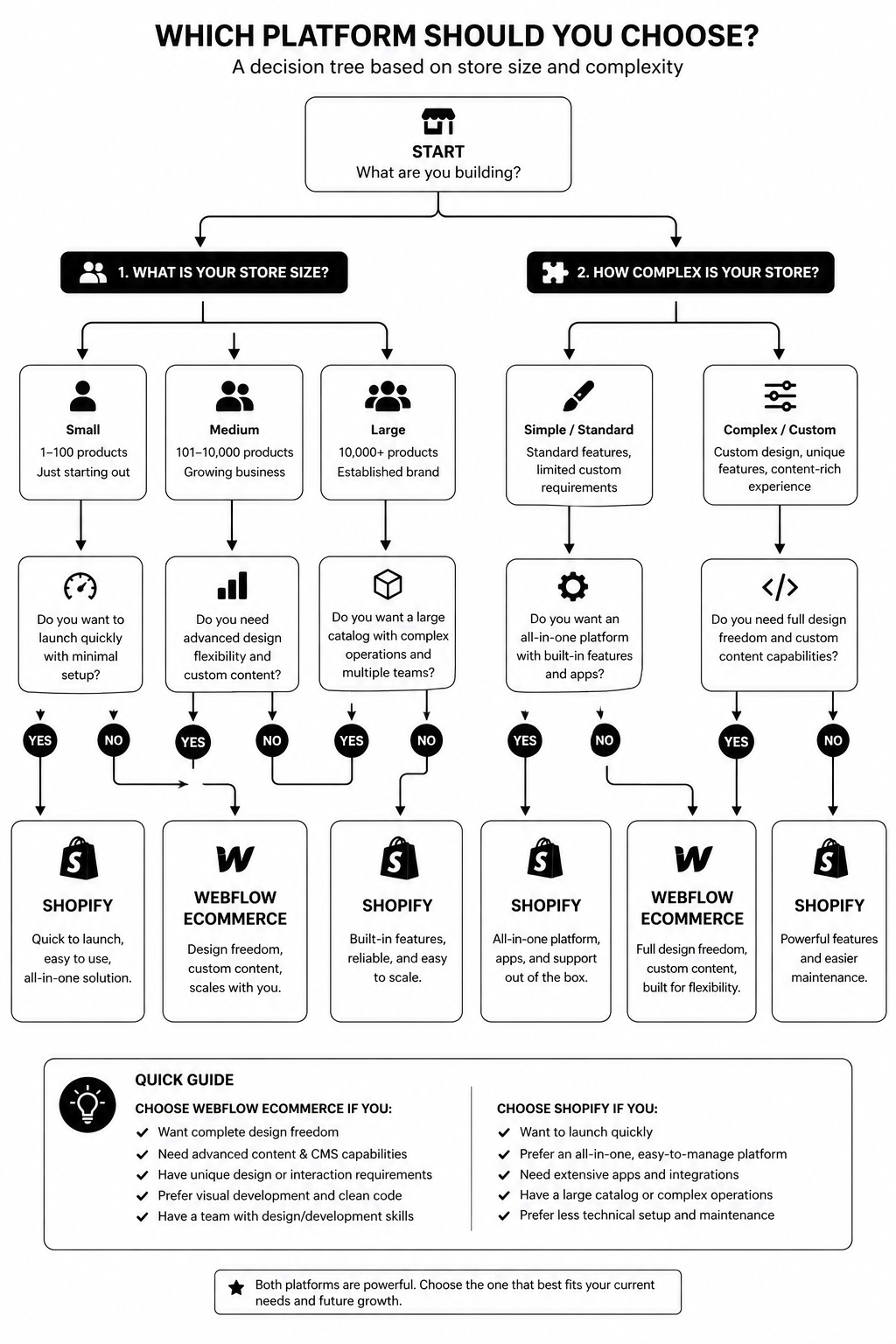
Step-by-Step: How to Choose Between Webflow Ecommerce and Shopify

  1. Count your SKUs and variants. >200 SKUs or complex variants → Shopify. ≤200 simple products → Webflow viable.
  2. Audit your fulfilment. Multi-location, 3PL integration, POS — Shopify. Single-fulfilment DTC — either works.
  3. Check international ambitions. Multi-currency / multi-region in next 24 months → Shopify Markets.
  4. Decide content-marketing priority. SEO and content are #1 acquisition channel → Webflow CMS (with or without Webflow Ecommerce).
  5. Assess design ambition. Custom interactions, brand-led storytelling sites → Webflow. Standard ecommerce store with minor branding → Shopify.
  6. Forecast subscription / B2B needs. Either coming in next 18 months → Shopify.
  7. Sanity-check the team. Marketing-led team that wants visual control → Webflow. Ops-led team that wants integrations → Shopify.

The hybrid play (more common in 2026 than people admit)

Many brands run Webflow for the marketing site and content hub, and Shopify for the store. Subdomain split (`www.brand.com` on Webflow, `shop.brand.com` on Shopify) keeps the design freedom for marketing while giving the commerce side Shopify's depth.Done well, this is the best of both. Done badly, you have two platforms to maintain. Worth it for brands above ~$2M GMV with serious content marketing.

Best Use Cases for Each

Webflow Ecommerce wins for

  • Design-led DTC brands (20–150 SKUs)
  • Premium / niche brands where site is part of the product
  • Studios and product brands with strong content marketing
  • Membership + light commerce hybrids
  • Sites where editorial > transactional

Shopify wins for

  • Anything above 200 SKUs
  • International / multi-currency stores
  • Subscription, B2B, or omnichannel (POS) brands
  • Brands scaling past $1M GMV in 12–24 months
  • Stores with complex fulfilment or 3PL integration

Common Mistakes When Choosing

  • Picking based on monthly subscription cost. Implementation and apps dwarf the plan price. TCO matters.
  • Underestimating SKU growth. A brand projecting 50 SKUs ends up at 300 in 18 months. Plan for the trajectory, not the snapshot.
  • Choosing Webflow because the designer recommends it. Designer fit and business fit aren't the same thing.
  • Choosing Shopify because the agency only knows Shopify. Same problem in reverse.
  • Ignoring the international roadmap. Multi-currency rebuilds are expensive — pick a platform that supports your trajectory.
  • Skipping the hybrid option. For content-heavy brands above $2M GMV, hybrid is often the right call.

FAQ — Webflow Ecommerce vs Shopify

Is Webflow Ecommerce good enough for serious brands?

Yes, up to a point. Brands selling 20–150 SKUs in a single market with strong content marketing are well-served. Past that, Shopify becomes the better fit.

Can I migrate from Webflow Ecommerce to Shopify later?

Yes — and many brands do. Product, customer, and order migration tools exist. Plan for SEO redirects on the migration; keep canonical URL structure where possible.

Does Shopify have anything close to Webflow's design flexibility?

With Online Store 2.0 sections, custom theme development, and now Hydrogen for headless builds — closer than people think. Still not parity. See Shopify Hydrogen guide.

Which platform is better for SEO?

Webflow has the cleaner technical SEO baseline. Shopify caught up but still has known issues (duplicate URLs from collections, blog limitations). For content-driven SEO strategies, Webflow wins.

Are Webflow Ecommerce transaction fees lower than Shopify's?

Webflow charges 0% transaction fees on Plus and Advanced plans. Shopify charges 0% if you use Shopify Payments, otherwise 0.5%–2% depending on plan. Net cost is similar at scale.

Can I run Webflow for marketing and Shopify for ecommerce?

Yes — and for content-heavy brands above ~$2M GMV, this hybrid is often the right architecture. Subdomain split keeps both platforms doing what they're best at.

Conclusion: Pick for the Brand You're Building, Not the One You Have

The honest answer to Webflow Ecommerce vs Shopify: Shopify if commerce is the product, Webflow if the site is part of the product. Above 200 SKUs, international, subscription, or B2B — Shopify, almost always. Design-led DTC under 150 SKUs with content as the growth engine — Webflow.If you're between the two and the trade-offs feel close, the hybrid setup is worth a serious look. Our team has shipped both pure-play and hybrid builds for brands across the UK and USA. Book a free platform consultation and we'll point you at the right answer in 30 minutes.Download the Ecommerce Platform Decision Matrix V2 — the scoring framework we use on every platform call.

Webflow Ecommerce vs Shopify Decision Guide — platform comparison checklist, feature comparison matrix, cost calculator, scalability assessment, SEO evaluation worksheet, migration planning template, and decision framework to help you choose the right ecommerce platform for your business.

Webflow SEO Checklist: 27 Optimizations That Move Rankings in 2026
Webflow

Webflow SEO Checklist: 27 Optimizations That Move Rankings in 2026

Webflow ships with cleaner SEO defaults than most CMS platforms. That's true. It's also why most Webflow sites stop optimising after the basics and never crack page one for competitive keywords. Strong defaults are not a strategy.This Webflow SEO checklist is the 27-item playbook our Webflow agency works through on every site we ship — covering technical SEO, on-page optimisation, structured data, internal linking, and the 2026-specific signals (AI search visibility, INP, helpful-content signals) that move rankings now.If you haven't built the CMS architecture yet, start with the Webflow CMS tutorial — clean information architecture is half the SEO battle.

What Makes Webflow SEO Different from WordPress SEO?

Webflow does three things WordPress can't without plugins: ships clean semantic HTML by default, hits Core Web Vitals scores in the 90s with zero work, and gives you canonical, robots, and meta controls per page natively.What it doesn't ship: an SEO plugin doing 40 things in the background. That means every optimisation is intentional. The upside — no plugin bloat, no conflicts, faster site. The downside — if you skip an item, no automation will catch it. Hence: a checklist.

Why Webflow SEO Matters in 2026

Three forces decided the 2026 Webflow SEO landscape.1. Core Web Vitals (especially INP) are confirmed ranking signals. The 2024 INP migration filtered slow sites out of competitive SERPs. Webflow's modern templates pass INP without effort — but only if you don't load 14 third-party scripts on top.2. AI search engines (Perplexity, SGE, ChatGPT search) are picking citation sources by structured data quality. Webflow sites with clean schema get cited proportionally more often than legacy WordPress sites with messy markup.3. Google's helpful-content system rewards topical depth over keyword stuffing. Webflow's CMS reference architecture (when built right) makes building real topical authority straightforward.

Webflow SEO

The 27-Item Webflow SEO Checklist

Technical foundation (items 1–9)

  1. Set a custom domain on a paid plan. Webflow.io subdomains don't index well. Hosting plan, custom domain, day one.
  2. Force HTTPS in Project Settings. Non-negotiable. Webflow handles the certificate.
  3. Configure www vs root canonical. Pick one, redirect the other. Webflow's hosting forces a 301 if configured correctly.
  4. Submit sitemap.xml to Google Search Console and Bing. Webflow auto-generates it; submit manually the first time and on every major navigation change.
  5. Set robots.txt to allow indexing of the live site only. Block staging subdomains. Webflow lets you set this per project.
  6. Configure 301 redirects in Project Settings → Hosting. Especially after migrations or slug changes. Never rely on client-side JS redirects for SEO.
  7. Set canonical URLs on every page. Default canonical = current URL. Override only for true duplicate-content scenarios (UTM-heavy landing pages).
  8. Hreflang tags for multi-region sites. Use Webflow Localization or hand-rolled hreflang in custom head code for UK/USA splits.
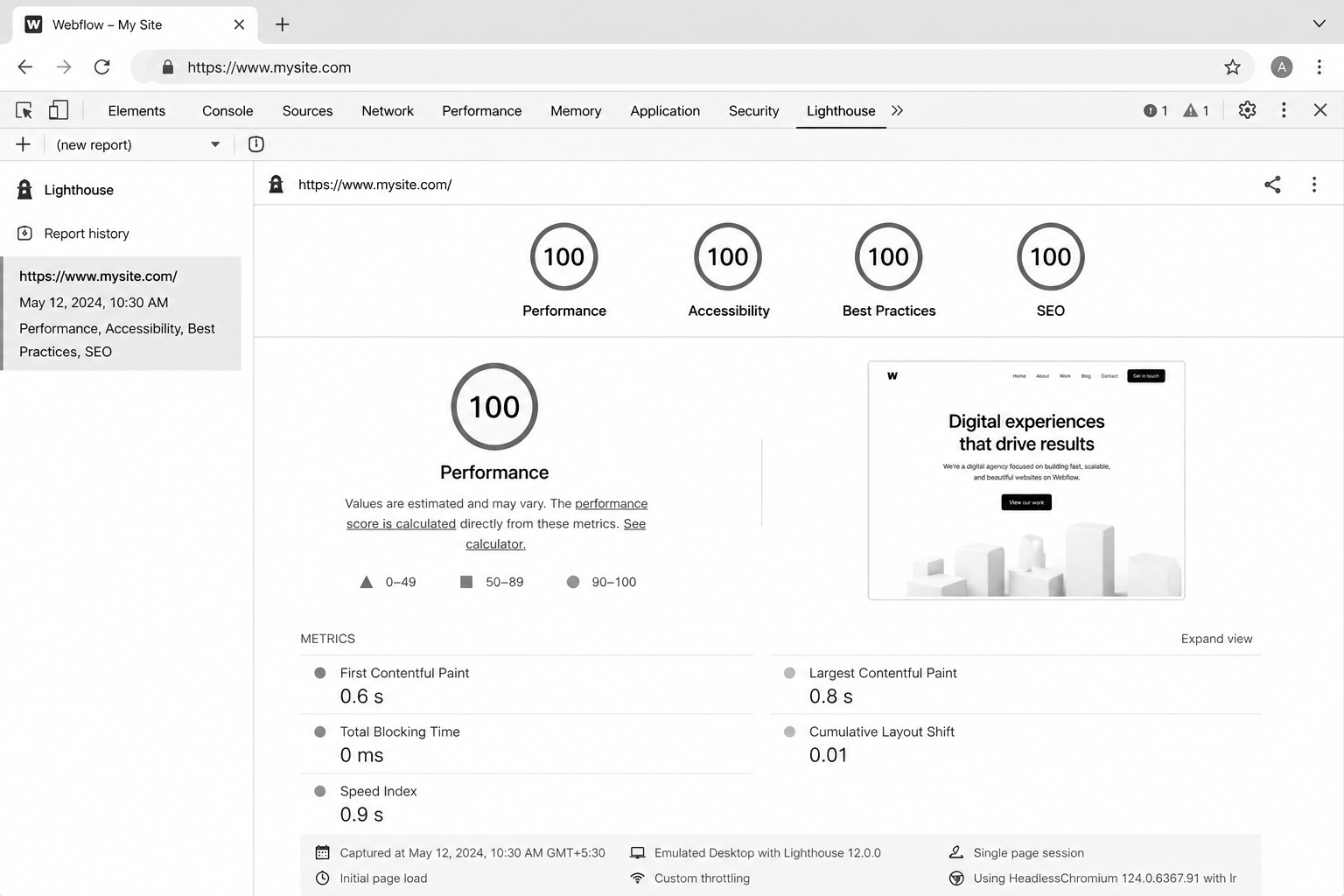
  9. Audit Core Web Vitals on PageSpeed Insights. Target LCP <2.5s, INP <200ms, CLS <0.1. Webflow defaults usually pass; third-party scripts kill them.

On-page optimisation (items 10–18)

  1. One H1 per page. Webflow lets you set any element as H1; verify in the Designer that you only have one per page.
  2. SEO Title set per page (separate from H1 — they should differ).
  3. Meta Description set per page. 140–155 chars, written for click-through, not keywords.
  4. Open Graph and Twitter Card images set per page. 1200×630 minimum for OG.
  5. Slugs short and keyword-led. No dates, no IDs, no stop words.
  6. Alt text on every image, set in the asset panel and on the image element.
  7. Internal links use descriptive anchor text, not "click here" or "this article."
  8. External links open in same tab unless explicitly required to open in new (rel="noopener" for new-tab links).
  9. Heading hierarchy follows logical depth. H2 → H3 → H4. Skipping levels confuses screen readers and search engines.

Mid-article CTA → Want a free audit of your Webflow site against this checklist? Request a free Webflow SEO audit — we'll deliver a 27-point report within 5 business days.

Structured data and schema (items 19–22)`

  1. Article schema on all blog posts. Add via custom code embed in the Collection Page template, populated with CMS fields.
  2. Organization schema in the global head. Logo, social profiles, contact info.
  3. BreadcrumbList schema wherever breadcrumbs exist visually.
  4. FAQPage schema on posts with FAQ sections. Major SGE / AI search citation driver.

Speed, performance, and INP (items 23–25)

  1. Compress all images before upload. Webflow auto-converts to WebP, but oversized originals waste bandwidth.
  2. Lazy-load below-the-fold images. Webflow has a per-image setting — use it.
  3. Audit third-party scripts ruthlessly. Heatmap tools, chat widgets, and tag managers each cost INP. Load via GTM with conditional firing where possible.

Internal linking and topical authority (items 26–27)

  1. Every blog post links to ≥2 sibling posts and ≥1 service page. Use Multi-Reference Tags to surface related posts dynamically.
  2. Pillar posts receive ≥4 inbound internal links from supporting cluster posts. Audit quarterly with Screaming Frog.

Best Tools for Webflow SEO Audits

  • Ahrefs Site Audit — strongest crawler for Webflow sites. Catches canonical, redirect, and broken-link issues.
  • Screaming Frog SEO Spider — best for internal linking audits and pillar inbound counts.
  • Google Search Console — non-negotiable. Performance and Indexing reports drive priority.
  • PageSpeed Insights — Core Web Vitals per page. Mobile and desktop separately.
  • Schema Markup Validator — verify every schema block before pushing live.
  • Ahrefs Webmaster Tools (free) — backlink monitoring without a paid subscription.

Common Webflow SEO Mistakes

  • Leaving the Webflow.io subdomain indexable after launch — duplicate content with the production domain. Block in robots.txt at staging.
  • Setting H1 from a Heading element with default H2 styling. Looks fine, fails the audit.
  • Using the CMS Item name as both H1 and SEO Title — wastes the SEO Title slot.
  • Bloating with third-party scripts after launch. Webflow's clean defaults are reversible.
  • Ignoring Search Console coverage errors for the first 90 days post-launch — when most indexation issues surface.
  • Slug changes without 301 redirects. Loses rankings instantly.

FAQ — Webflow SEO

Is Webflow good for SEO compared to WordPress?

Out of the box, better. Cleaner HTML, faster CWV, fewer plugin conflicts. WordPress can match Webflow with the right plugins and a good developer, but Webflow gets you 80% there with zero configuration.

Does Webflow handle structured data?

Yes, via custom code embeds in the head or per Collection Page template. There's no native schema plugin, but the manual approach gives you cleaner output than most WP plugins produce.

How long does Webflow SEO take to show results?

Technical fixes show in Search Console within 2–4 weeks. Content and topical authority compound over 4–9 months. Don't judge SEO on 30-day windows.

Can I rank a Webflow site for competitive keywords?

Yes, but the platform isn't the bottleneck — content quality, internal linking, and backlinks are. Webflow won't rank a thin site for "CRM software" any more than WordPress would.

Does Webflow's CMS hurt SEO at scale?

Not when architected correctly. See the Webflow CMS tutorial for the data model that scales to 5,000+ items without performance loss.

How does Webflow SEO compare for UK and USA businesses?

Identical platform behaviour. The differences come from content (regional pricing, case studies, hreflang for region-specific URLs). Webflow Localization handles UK/USA splits cleanly when needed.

Conclusion: Ship the Checklist, Then Compete on Content

Most Webflow sites stop at items 1–9. The top 1% finish all 27 and treat the checklist as a quarterly audit, not a launch task. The compounding gain over 12 months is significant — both for traditional Google rankings and for emerging AI-search citation surfaces.If you'd rather have a specialist run the audit and implement the fixes, our team does this for SaaS and B2B Webflow clients across the UK and USA. Book a free Webflow SEO audit and we'll deliver a prioritised 27-point report within 5 business days.Download the printable Webflow SEO Checklist PDF — the exact 27-item audit our team runs.

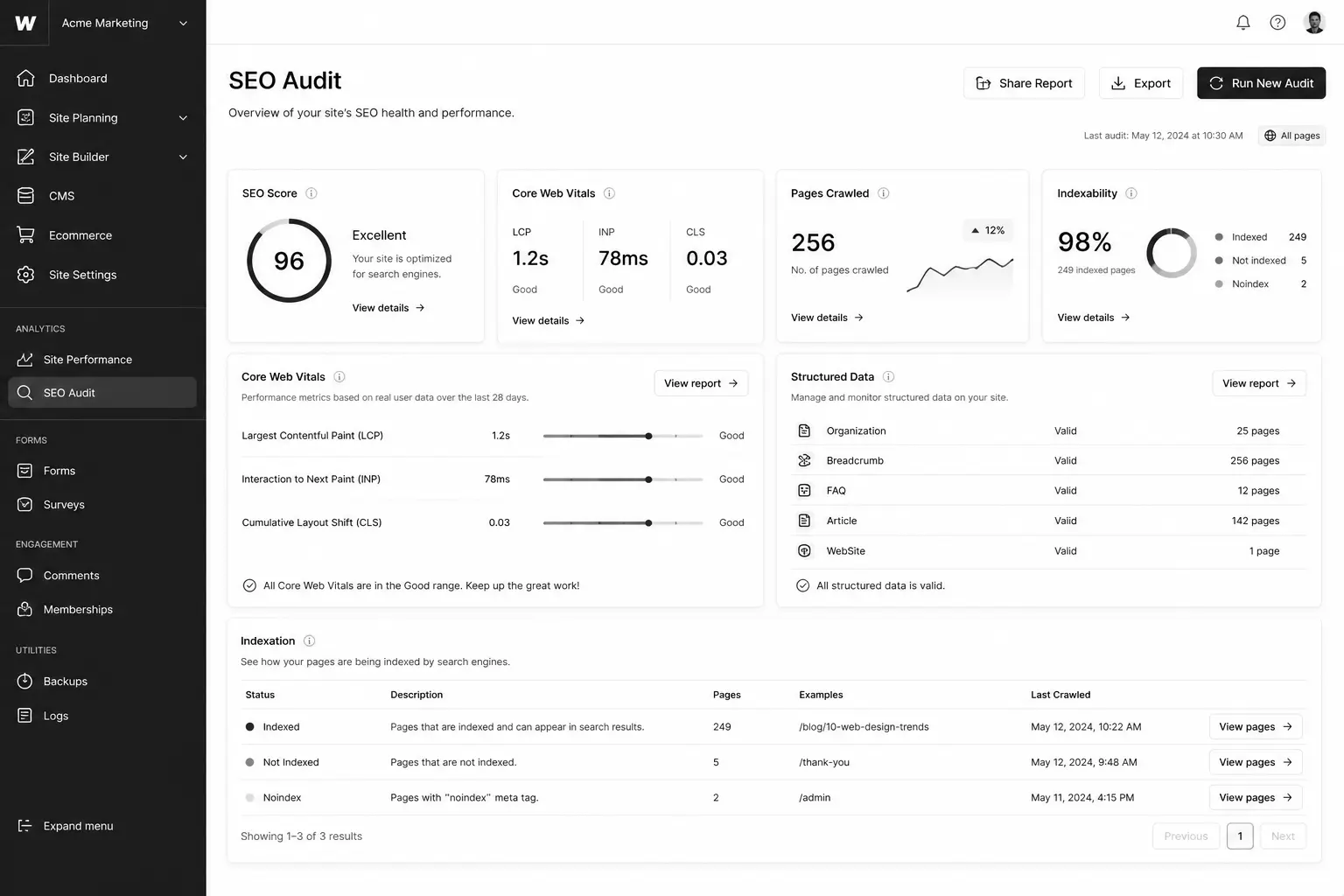
Webflow SEO Optimization Toolkit — technical SEO checklist, Webflow CMS SEO planner, keyword mapping template, on-page optimization worksheet, Core Web Vitals checklist, internal linking planner, and SEO KPI dashboard to improve rankings and build a scalable Webflow SEO strategy.