Inbound WebHub logo
Web Development
Resources
Free audit
Free HubSpot Portal Audit
Get an instant audit of your HubSpot portal with actionable insights to improve CRM setup, automation, marketing, and overall performance.
Start Free Audit
button arrowbutton arrow
White Label
Agency

White Label AEO Services: How Agencies Sell AI Search Visibility

time
12 MIN
date
November 9, 2026
White Label AEO Services: How Agencies Sell AI Search Visibility
In this article

Short answer: White-label AEO (answer engine optimization) lets your agency sell AI search visibility, meaning getting clients cited by ChatGPT, Perplexity, Gemini and Google AI Overviews, while a partner does the audits, schema, content and tracking under your brand. AEO retainers typically sell for $1,000–$12,000 a month in 2026, and baseline audits for $1,500–$5,000, so agencies can package it as a new service line without hiring specialists.

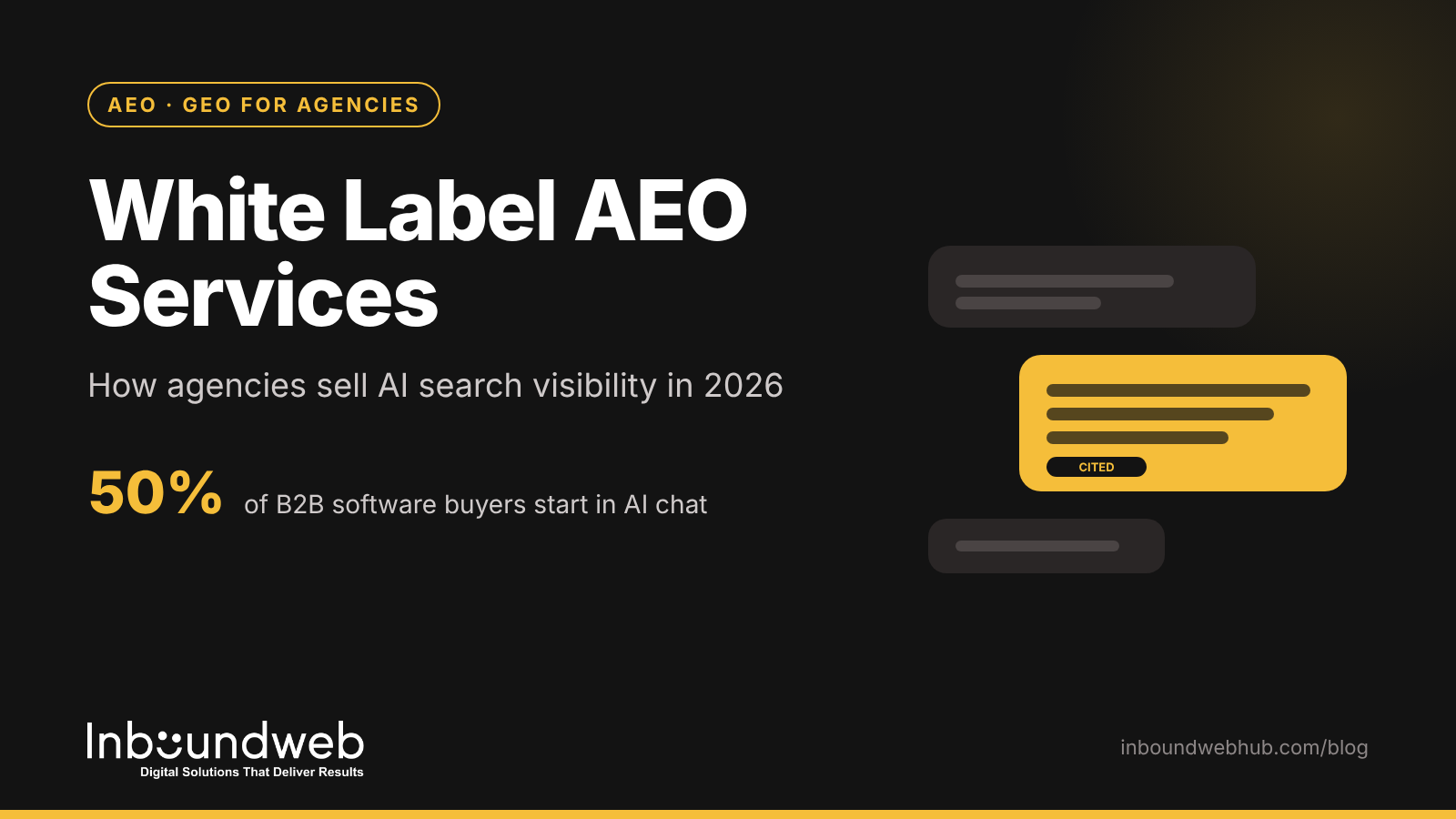
Clients are already asking for it. Half of B2B software buyers now start their research in an AI chatbot rather than Google, according to a 2026 G2 buyer survey. When a prospect asks ChatGPT "who are the best HubSpot partners for SaaS," your client either appears in that answer or doesn't. This guide covers what white-label AEO includes, how to price and package it, and how to choose a delivery partner.

Key takeaways

  • AEO, GEO and SEO overlap but measure different things: rankings and clicks for SEO, citations and brand mentions in AI answers for AEO and GEO.
  • Typical 2026 pricing: $1,500–$5,000 for an audit; $1,000–$3,500 a month entry level, $4,000–$12,000 for mid-market retainers.
  • What a white-label partner delivers: AI visibility audits, schema, answer-first content, entity cleanup, off-site citation work and branded monthly reports.
  • Content that gets cited answers early, includes statistics and sources, and is updated at least quarterly.
  • Start with an audit offer to existing SEO clients. It's the easiest upsell and shows the gap in numbers.

What is white-label AEO?

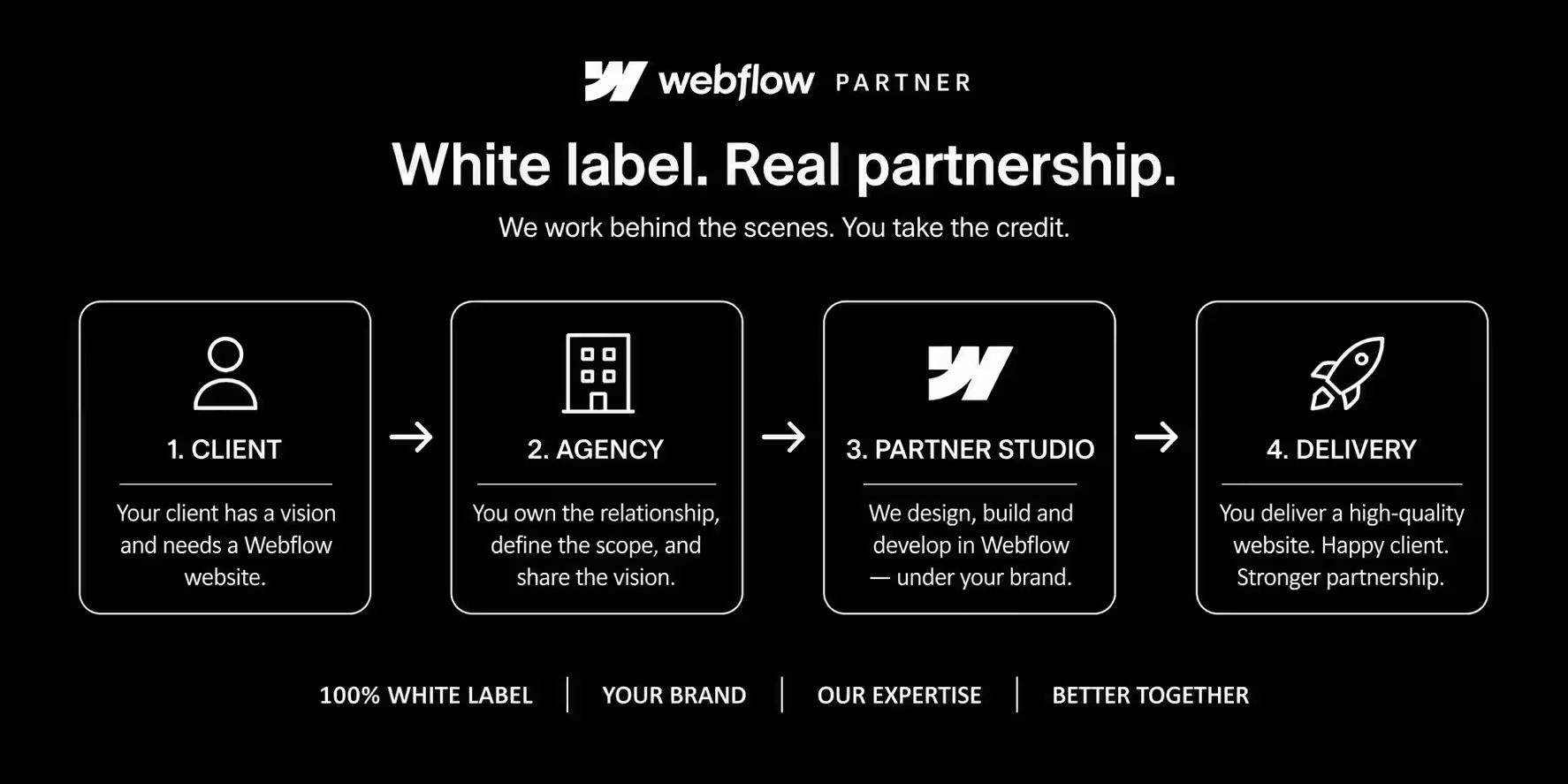
White-label AEO is answer engine optimization delivered by a specialist partner and resold by your agency under your own brand. The partner runs the audits, implements schema and content changes, and produces reports with your logo. Your client sees only your agency, while you keep the relationship, the strategy and the margin.

It works the same way as white-label SEO or web development: the contract and invoice stay with you, and the partner is a cost line, not a competitor. If you've used a white-label partner for builds, the model is familiar. See our guide to white-label web development for agencies.

AEO vs GEO vs SEO: what's the difference?

SEO optimizes pages to rank and earn clicks in search results. AEO optimizes content so answer engines can lift a direct answer from it. GEO (generative engine optimization) works on how AI models describe and recommend a brand across many sources. In practice, agencies sell AEO and GEO together because the work overlaps.

SEOAEOGEO
GoalRank pages and win clicksBe the quoted answerBe the recommended brand
Where it showsGoogle and Bing resultsAI Overviews, featured snippets, voice and chat answersChatGPT, Perplexity, Gemini, Claude, Copilot
Main leversKeywords, links, technical healthAnswer-first structure, FAQ and schema, freshnessEntity consistency, third-party mentions, citations, reviews
Key metricsRankings, organic trafficAnswer inclusion, snippet shareCitation rate, share of AI voice, AI referral traffic

We break down each discipline on our AEO, GEO and SEO service pages.

Why are clients asking agencies for AEO now?

Clients want AEO because buyers increasingly research in AI tools and see fewer classic search results. About a quarter of Google searches now trigger an AI Overview, and ChatGPT drives about 87% of AI referral traffic, per Conductor's 2026 benchmarks. Brands that aren't cited in those answers lose visibility even when their rankings hold.

  • Buyers start in chat. 50% of B2B software buyers begin in an AI chatbot, and 74% of those use ChatGPT (G2, 2026).
  • AI is in almost every deal. 89% of B2B buyers used generative AI in at least one phase of their purchase (Forrester, 2024).
  • Third parties matter. Brands are 6.5× more likely to be mentioned through third-party sources than their own site (AirOps, 2025).

Statistics compiled by Elite Content Marketer's 2026 GEO and AEO statistics roundup.

What does a white-label AEO service include?

A complete white-label AEO service includes an AI visibility audit, technical fixes such as schema and crawler access, answer-first content, entity cleanup across the web, off-site citation building and branded monthly reporting. The partner does the work; your agency owns strategy and the client conversation.

  1. AI visibility audit. Test 30–100 buyer prompts across ChatGPT, Perplexity, Gemini and AI Overviews. Record where the client and competitors are named and cited.
  2. Technical foundation. Article, FAQPage, Organization, Product and BreadcrumbList schema; crawler access in robots.txt; an llms.txt file; fast, crawlable pages.
  3. Answer-first content. Rewrite key pages and publish new posts that answer each target question in the first 40–60 words, with stats, sources and a table.
  4. Entity consistency. Align company facts, founding date, services and leadership across the website, LinkedIn, Google Business Profile, Clutch, G2 and directories.
  5. Off-site citations. Get listed in the "best of" articles, comparison pages, communities and review sites that AI engines already cite for the category.
  6. Reporting. Monthly citation rate, prompt coverage, share of AI voice versus competitors, and AI-referred traffic and leads, all on your branded template.
What gets cited: GEO-BENCH tests found adding statistics, quotations and source citations improved AI visibility by up to 41%. Pages updated within three months earn about 6 ChatGPT citations versus 3.6 for stale pages (SE Ranking, 2025).

How much should agencies charge for AEO?

Agencies typically charge $1,500–$5,000 for a one-time AEO audit and $1,000–$12,000 a month for ongoing AEO and GEO retainers in 2026, depending on client size and content volume. Enterprise and regulated-industry programmes start around $15,000 a month.

PackageTypical client price (USD)Typical clientWhat's included
AI visibility audit$1,500–$5,000 one-timeAny existing SEO clientPrompt testing, competitor citations, schema gaps, prioritised roadmap
Starter retainer$1,000–$3,500/monthSmall B2B firms, local brandsSchema, 2–4 answer-first pieces, monthly citation report
Growth retainer$4,000–$12,000/monthB2B SaaS and ecommerce with an SEO programmeContent engine, entity cleanup, off-site citation work, pipeline reporting
Enterprise$15,000+/monthGlobal, regulated or multi-brand companiesDedicated specialists, global schema architecture, digital PR

Market ranges from 310 Creative's 2026 AEO agency pricing guide (updated August 2026). Price the outcome, not the hours, and keep the partner's cost below 50% of the retainer so your margin survives reporting and client calls.

How to package AEO for your existing clients

The easiest way to launch AEO is as an add-on to existing SEO or content retainers, starting with a paid audit. The audit shows the client exactly which prompts competitors win, which turns a vague "AI search" conversation into a concrete gap they'll pay to close.

  1. Pick 10 pilot clients with active SEO retainers and decent content libraries.
  2. Run audits on 30–50 buyer prompts each, showing a share-of-voice chart versus three competitors.
  3. Offer a 90-day sprint covering schema, 6–10 answer-first pages and entity cleanup.
  4. Convert to a retainer with monthly citation reporting once the first gains show.

How to choose a white-label AEO partner

Choose a white-label AEO partner that can show its own AI visibility, explain its prompt-testing method, implement schema on your clients' platforms, and report under your brand. Also check that it can actually edit the CMS your clients use, because most AEO fixes happen on the website.

  • Proof on its own brand. Ask which prompts the partner is cited for in ChatGPT and Perplexity.
  • A repeatable method. A documented prompt set, testing cadence and scoring model.
  • Platform skills. Hands-on HubSpot CMS, Webflow, WordPress and Shopify implementation, not just recommendations.
  • White-label hygiene. NDA, no-poach, unbranded deliverables and your report template.
  • Honest claims. No partner can guarantee citations. Walk away from anyone who promises "#1 in ChatGPT."

How Inbound WebHub delivers white-label AEO

Inbound WebHub delivers AEO, GEO and SEO for agencies under their brand, backed by 1,100+ projects since 2017 and platform teams for HubSpot, Webflow, WordPress and Shopify. That means we can fix schema, rewrite pages and publish content directly in your client's CMS, not just send a report. Explore our AEO services, read how agencies scale with a white-label partner, or talk to us about a pilot audit.

Free downloads: AEO playbook and white-label toolkit

Want to put this into practice? Both guides are free, branded PDFs you can use with your team or adapt for client work.

FAQ

What does white-label AEO mean?

It's answer engine optimization delivered by a partner and resold by your agency under your brand. The partner does the audits, schema, content and reporting; your client only sees your agency.

Is AEO different from SEO?

Yes. SEO aims to rank pages and win clicks. AEO aims to have AI engines quote your content as the answer. Strong SEO helps, but AEO adds answer-first structure, schema, freshness and third-party citations.

How much do agencies charge for AEO services?

Typical 2026 pricing is $1,500–$5,000 for an audit and $1,000–$12,000 a month for retainers, with enterprise programmes from about $15,000 a month.

How long does AEO take to show results?

Technical fixes and refreshed pages can start appearing in AI answers within weeks of being crawled, but consistent citation gains usually take 3–6 months of content and off-site work.

Can a partner guarantee my client appears in ChatGPT?

No. AI answers vary by prompt, user and model version, so no one can guarantee placement. A good partner commits to a method, a prompt set and transparent reporting instead.

FAQ

What does white-label AEO mean?
faq-arrow
It's answer engine optimization delivered by a partner and resold by your agency under your brand. The partner does the audits, schema, content and reporting; your client only sees your agency.
Is AEO different from SEO?
faq-arrow
Yes. SEO aims to rank pages and win clicks. AEO aims to have AI engines quote your content as the answer. Strong SEO helps, but AEO adds answer-first structure, schema, freshness and third-party citations.
How much do agencies charge for AEO services?
faq-arrow
Typical 2026 pricing is $1,500–$5,000 for an audit and $1,000–$12,000 a month for retainers, with enterprise programmes from about $15,000 a month.
How long does AEO take to show results?
faq-arrow
Technical fixes and refreshed pages can start appearing in AI answers within weeks of being crawled, but consistent citation gains usually take 3–6 months of content and off-site work.
Can a partner guarantee my client appears in ChatGPT?
faq-arrow
No. AI answers vary by prompt, user and model version, so no one can guarantee placement. A good partner commits to a method, a prompt set and transparent reporting instead.
KEEP BUILDING
title arrow

You've got the plan. Let's build it.

We turn the frameworks you just read into the flows, pages, and automation behind them — under your brand, always.

Keep reading

View all articles
button arrowbutton arrow
Outsource Web Design vs In-House: What Actually Scales
Agency
Website Redesign

Outsource Web Design vs In-House: What Actually Scales

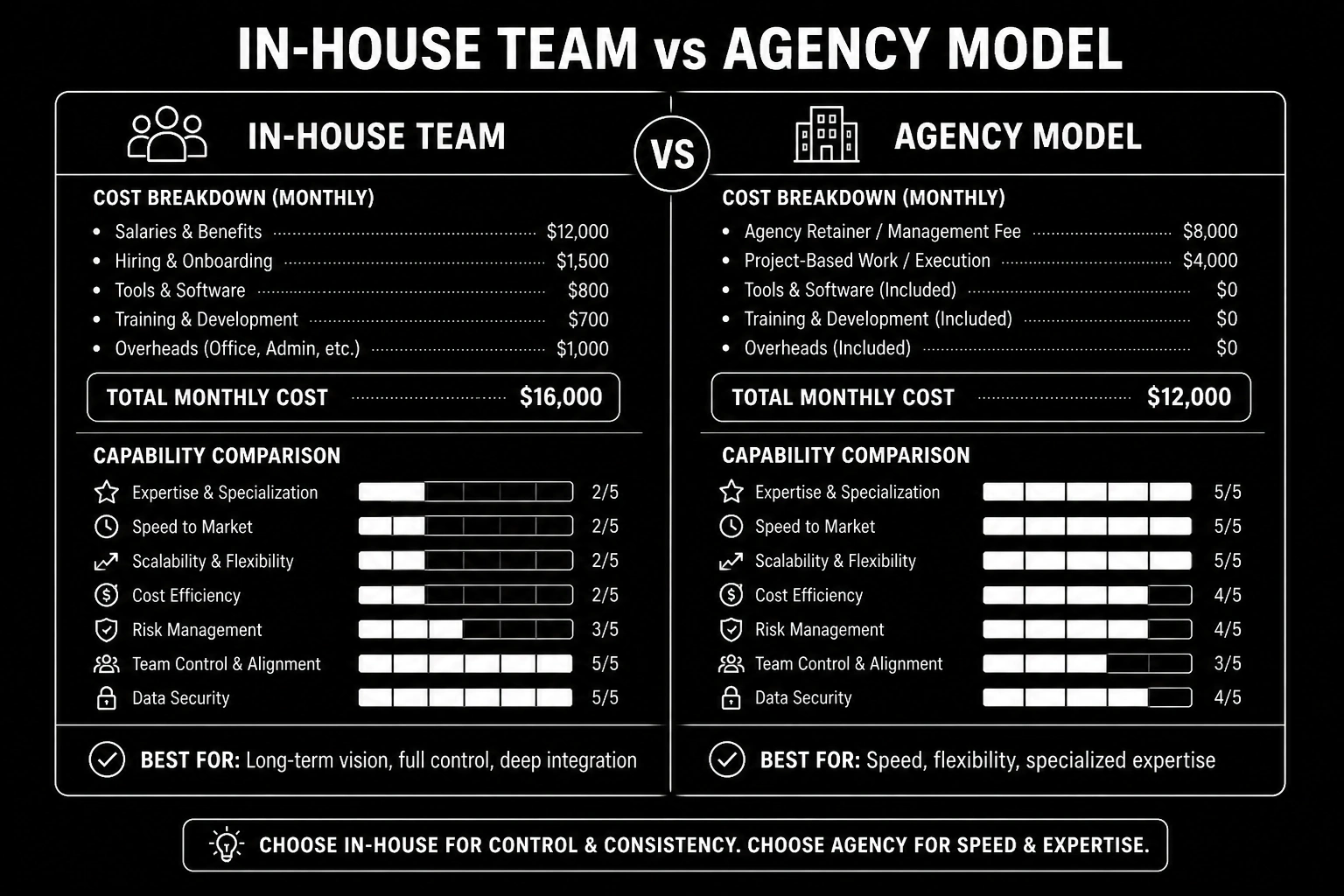
Every growing company reaches the same question: should web design stay with an agency or move in-house? The usual answer, "it depends", is true but unhelpful. It depends on a few specific things you can measure: how much design work you have, how steady it is, which skills you need and how quickly you need them.

This guide compares outsourcing and in-house web design on cost, speed, quality and scale, and gives you a simple way to decide which model, or which mix, fits your team.

The three models

  • In-house team. Designers and developers on your payroll, working only on your brand.
  • Outsourced agency or partner. An external team that delivers projects or ongoing work under a contract.
  • Hybrid. A small in-house core (often a design lead or web manager) that owns the brand and roadmap, with an outside partner for build capacity and specialist skills.

Most companies that scale their website well end up hybrid, but the right starting point depends on your situation.

Side-by-side comparison

FactorIn-houseOutsourcedHybrid
Cost structureFixed salaries, benefits, tools and management timeVariable; pay for projects or a retainerSmall fixed core plus variable build cost
Time to startMonths to recruit and onboardWeeksWeeks, once the core is in place
Brand knowledgeDeep and constantBuilds over time; needs good briefsHeld by the in-house core
Skill rangeLimited to the people you hireBroad: design, development, SEO, CRO, QABroad, with in-house direction
Speed on small changesFastDepends on the retainer and processFast for small changes; partner for larger builds
Scaling up or downSlow and costlyEasyEasy
Risk if a person leavesHighLow; the partner coversModerate

When in-house makes sense

  • You have a steady, high volume of design and development work every week.
  • The website is your product or your main sales channel, and changes ship daily.
  • You can offer designers and developers enough variety and career growth to keep them.
  • You have someone who can manage and review technical work.

When outsourcing makes sense

  • Work comes in projects: a redesign, a migration, a new product launch.
  • You need several skills at once (UX, UI, development, SEO, accessibility) but not full-time.
  • You need to move faster than recruiting allows.
  • You want experience from many similar projects rather than one person's view.

How to compare the real cost

Salary is only part of the in-house cost. Add recruitment, benefits, equipment, software licences, training, management time and the cost of gaps when someone is on leave or leaves. For outsourcing, add your internal time to brief, review and approve work, plus a buffer for changes.

Then compare both against the same 12-month workload. If the in-house team would sit partly idle between projects, outsourcing usually wins. If they would be fully utilised all year, in-house often wins over time. Our website redesign cost guide helps you estimate the project side.

In-house vs outsourced web design

Making outsourcing work

Outsourcing fails when it's treated as "send a brief, get a website". It works when it's run as a partnership:

  1. One internal owner. A single person who sets priorities, gives feedback and approves work.
  2. A written brief for every project. Goals, audience, pages, content status, integrations, deadlines and success measures.
  3. A design system. Shared components and styles so every new page looks consistent, whoever builds it.
  4. A regular rhythm. Weekly check-ins and milestone demos, not a surprise reveal at the end.
  5. Clear ownership. Domains, hosting, CMS accounts, design files and code all in your company's name.
  6. A start with a pilot. One landing page or a small section before a full redesign.

Questions to ask a potential partner

  • Can we see sites you built that are still live and maintained?
  • Who will actually do the work, and will that change mid-project?
  • How do you handle feedback rounds and scope changes?
  • What does your QA process cover before handover?
  • What happens after launch: support, maintenance and small changes?

Our list of tips for choosing a web development agency goes further.

The hybrid model in practice

A common setup for growing B2B companies is one in-house web or design lead who owns the brand, roadmap and CMS, supported by an external partner on a monthly retainer for builds, development and specialist work. The lead keeps decisions fast and consistent; the partner provides capacity and breadth without adding headcount. Agencies use the same model in reverse, outsourcing builds to a white-label partner while keeping design and client relationships.

FAQ

Is outsourcing web design cheaper than hiring?

Usually, when work is irregular or needs several skills. With steady full-time workloads, in-house can be cheaper over time.

Will an outside team understand our brand?

Yes, if you give them a clear brand guide, design system and an internal owner to give feedback. Brand knowledge builds quickly with a consistent partner.

How do we avoid being locked in to an agency?

Keep every account, file and repository in your company's name, and ask for documentation as part of every project.

Can we start outsourced and move in-house later?

Yes. Many companies outsource the redesign, then hire a web manager to run the site with the partner on a smaller retainer.

Conclusion

Choose the model that matches your workload, not your preference. Steady, daily work favours in-house; project-based, multi-skill work favours outsourcing; most growing teams do best with a small in-house core and a reliable partner. If you're weighing your options, see our web design and website maintenance services, or book a call.

The In-House vs Agency Decision Guide — cost comparison worksheet, capability gap matrix, vendor evaluation scorecard, project governance template, pilot project checklist, 30/60/90-day rollout plan, and decision framework to choose the right web design model for long-term growth.

White Label HubSpot Agency: How Partners Scale Without Hiring
White Label

White Label HubSpot Agency: How Partners Scale Without Hiring

Most agencies don't lose HubSpot work because they can't sell it. They lose it because they can't staff it. A client asks for a theme rebuild, a WordPress migration and three integrations in the same quarter, and the one HubSpot developer you have is already booked. Hiring takes months, and a freelancer disappears the week before launch.

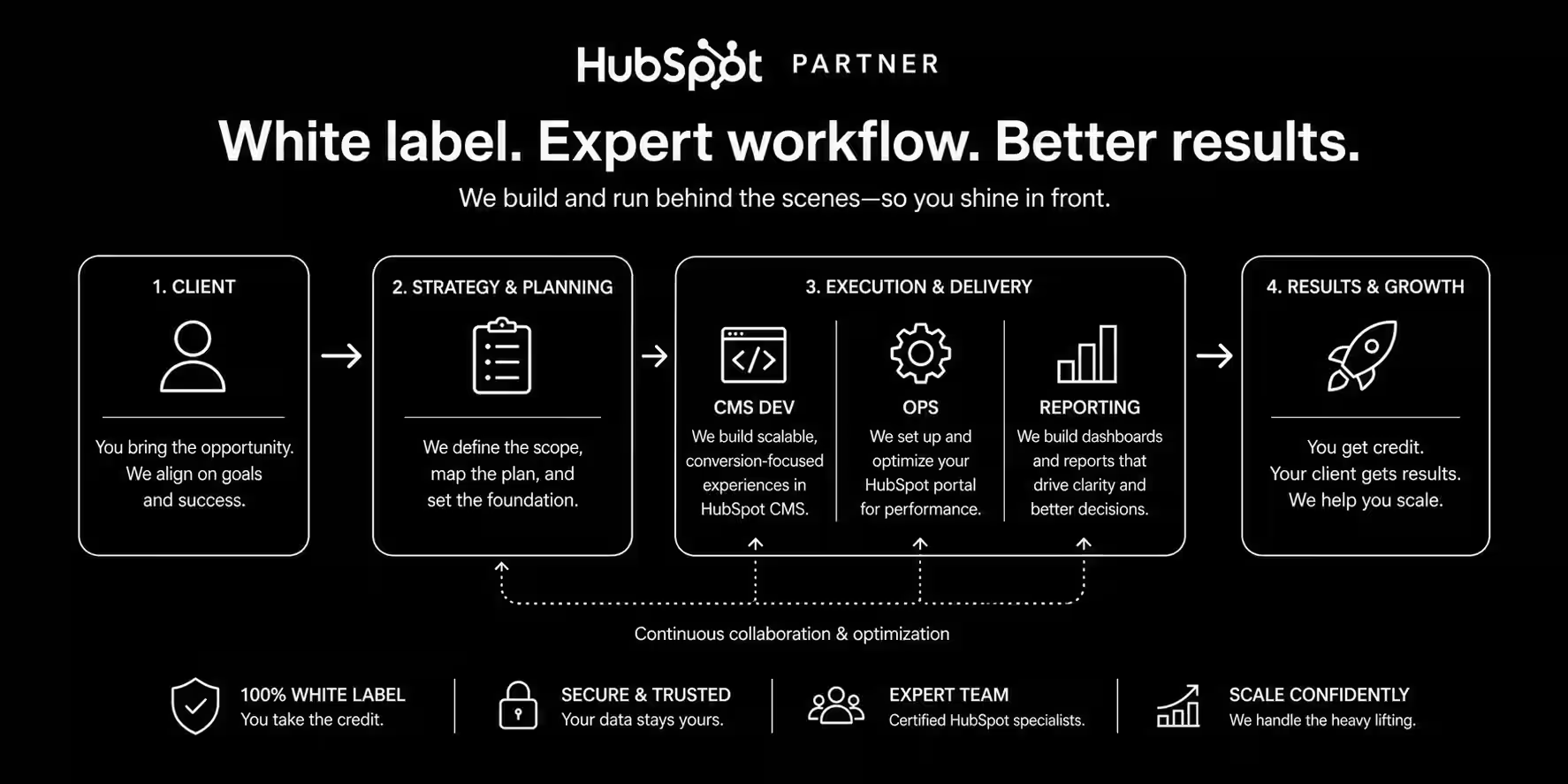
A white-label HubSpot partner fixes the staffing problem without changing who owns the client. You keep the relationship, the strategy and the margin. The partner does the build inside your process, under your brand, and your client never sees a second company. This guide covers what to hand over, how the work should run, how to price it and how to tell a good partner from a risky one.

What white-label HubSpot delivery actually means

White-label means the partner works as an invisible extension of your team. They join your project tools, follow your naming and QA rules, and hand finished work back to you to present. Nothing they deliver carries their name: not the code comments, not the module labels, not the email signatures on client calls (if they join calls at all).

It is different from referring work out. With a referral, the client becomes someone else's client. With white-label delivery, the contract, the invoice and the account stay with you. The partner is a cost line, not a competitor.

The HubSpot work agencies hand to a partner

Strategy usually stays in-house, because that is where your agency's value sits. Execution is what moves to the partner. The most common categories are:

  • CMS builds and themes. Converting Figma designs into a HubSpot theme with custom modules, drag-and-drop areas and theme settings marketers can actually use. See our HubSpot theme development service.
  • Migrations. Moving sites from WordPress, Webflow or Wix to HubSpot CMS, including content, blog posts, redirects and forms. Details on our WordPress to HubSpot migration page.
  • Portal onboarding. Properties, pipelines, lifecycle stages, user permissions and the first set of workflows. Our white-label onboarding covers this.
  • Workflows and automation. Lead nurturing, routing, lifecycle updates and internal notifications. The 12 workflows we recommend are a good starting list.
  • Integrations. Connecting HubSpot to billing, ERP, product data or contract tools through native apps, middleware or custom code. See HubSpot integrations.
  • Landing pages and ongoing tickets. The steady stream of page builds, module tweaks and fixes that eats senior time.

Partner, hire or freelancer: when each makes sense

White-label is not always the right answer. If you have steady, predictable HubSpot volume for a full-time role, hiring can be cheaper over time. The partner model wins when demand is lumpy, when you need several skills at once, or when you need capacity this month rather than next quarter.

FactorIn-house hireFreelancerWhite-label partner
Time to start2–4 months to recruit and onboardDays, if availableUsually 1–2 weeks
Cost when work is slowFull salary continuesNoneNone, or a small retainer
Skill rangeOne person's skillsOne person's skillsDevelopers, designers, QA and ops
Cover for sickness and holidaysGap in deliveryGap in deliveryTeam cover
Process and QAYours to buildVaries widelyShould come with its own, adapted to yours
Best forSteady, high volumeSmall, one-off tasksVariable volume and multi-skill projects

How a well-run white-label engagement works

1. Brief and scope

Every project starts with a written brief: goals, page list, module list, integrations, deadlines and who approves what. The partner should send back a scope with assumptions and a fixed price or hour estimate before any work starts. If a partner quotes without asking questions, expect change requests later.

2. Access

The partner works inside your client's portal using a user seat you control, or in a developer test account that you then deploy. You keep admin rights and can remove access the day the project ends. Never share your own login.

3. Build in your rhythm

Agree on one channel (your Slack, your project tool) and a fixed update cadence, such as a written update every two days and a demo at each milestone. The partner adapts to your process; you should not have to learn theirs.

4. QA before you see it

A good partner tests on desktop, tablet and mobile, checks module settings in the page editor, validates forms and tracking, and runs a speed and accessibility check before handing over. Your team then does a final review, not a first review.

5. Handoff under your brand

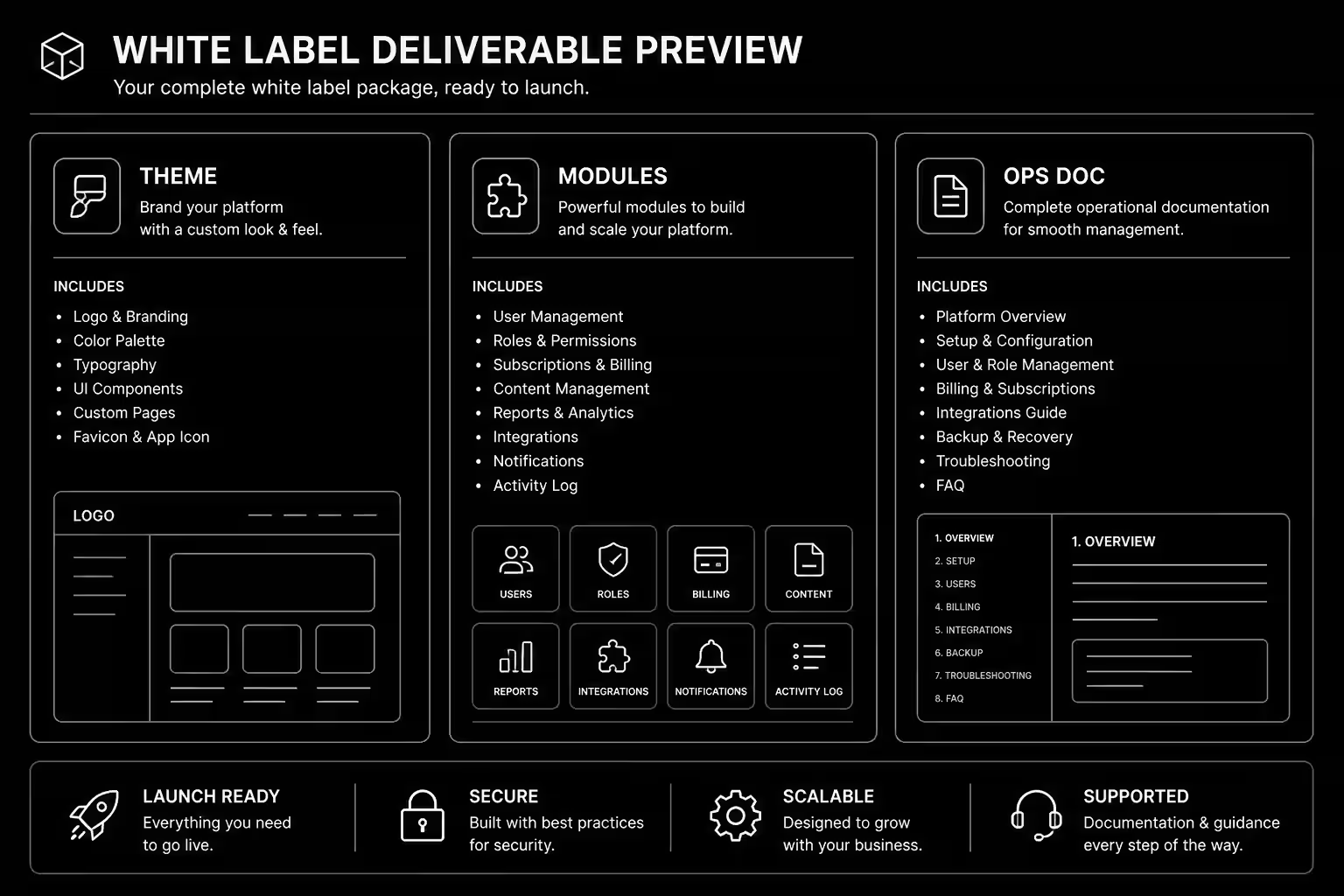
Documentation, training videos and module guides go out with your logo. The client receives a finished product from you.

White label HubSpot delivery process

Keeping the partnership invisible

Clients rarely mind that agencies use specialists. They mind finding out by accident. A few rules prevent that:

  • An NDA and a non-solicitation clause, so the partner never contacts your client directly.
  • Full IP assignment, so everything built belongs to you and your client.
  • No partner branding in code, module names, file paths or commit messages.
  • Partner staff use your agency email or a neutral alias if they ever join client calls.
  • All files live in your accounts: your Git repository, your Drive, your HubSpot developer account.

Pricing and margin

There are three common pricing models. Fixed price per project works well for theme builds and migrations with a clear scope. A monthly block of hours suits ongoing tickets and landing pages. A dedicated developer, billed monthly, suits agencies with enough steady work to keep one person busy but no wish to hire.

Whatever the model, work out your margin before you quote the client. Add the partner's price, your own project management and review time, and a buffer for changes, then price the client so that the total still leaves the margin your agency targets. If the numbers only work when nothing goes wrong, the scope is too thin.

Rule of thumb: never resell partner hours one-to-one. Sell the outcome (a theme, a migration, a working integration) and keep the hours as your internal cost.

How to vet a white-label HubSpot partner

Ask for evidence, not promises:

  1. HubSpot work you can inspect. Live sites built on HubSpot CMS, and ideally a sample module or theme repository.
  2. Certifications. HubSpot CMS for Developers and relevant hub certifications show they keep up with the platform.
  3. A written QA checklist. If they can't show one, they probably don't use one.
  4. Time-zone overlap. At least two to three working hours a day that overlap with yours.
  5. A paid pilot. Start with one landing page or a small module set before handing over a full rebuild.
  6. References from other agencies. Ask how the partner handled a missed deadline or a scope change, not only how good the work looked.

Common mistakes

  • Handing over a vague brief. The partner fills gaps with guesses, and you pay for the rework.
  • Skipping your own review. The client relationship is yours; so is the final quality check.
  • Choosing on hourly rate alone. A cheaper partner that needs twice the revisions costs more.
  • No exit plan. Keep documentation and code in your accounts so you can switch partners without starting over.

FAQ

Will my client know I use a white-label partner?

Not unless you tell them. With the right contract, branding rules and accounts set up in your name, the partner stays invisible.

Which HubSpot tasks should I not outsource?

Keep account strategy, client relationships and final sign-off in-house. Those are what clients pay your agency for.

How fast can a partner start?

For a defined project, one to two weeks is typical: a few days to scope, then onboarding into your tools.

Does the partner need its own HubSpot partner status?

No. The client's portal and any HubSpot partner tier stay with your agency. The partner works through access you grant.

What if the partner misses a deadline?

Agree on milestones, update cadence and remedies in the contract. Weekly demos make slippage visible early, while there is still time to fix it.

Conclusion

A white-label HubSpot partner lets you say yes to more of the work your clients already want to buy, without the fixed cost of new hires. Start small, insist on a written process and keep every account in your name. If you want to see how we run white-label HubSpot delivery for agencies, look at our white-label HubSpot development service or book a call.

The HubSpot White-Label Agency Toolkit — partner onboarding checklist, project brief, SLA template, delivery workflow, QA checklist, communication framework, and margin calculator for profitable white-label HubSpot partnerships.

White Label Webflow Partner: The Agency Scaling Model in 2026
White Label

White Label Webflow Partner: The Agency Scaling Model in 2026

Webflow has become the default build platform for many design-led agencies. Clients like the editing experience, designers like the control, and sites launch faster than on a traditional CMS. The catch is that a Webflow build still needs a developer's discipline: a clean class system, a CMS structure that scales, interactions that don't hurt performance and an SEO setup that survives the client's first round of edits.

Most agencies can design that site. Fewer can build three of them at once. A white-label Webflow partner gives you the build capacity while you keep the design, the client and the margin. This guide explains how the model works, what a good handoff looks like and how to keep quality and margin under control.

How the white-label Webflow model works

Your team owns discovery, strategy and design. The partner takes approved Figma files and turns them into a production Webflow site, working in a workspace you control and following your naming and QA rules. When the build passes QA, you present it to the client as your own work.

The client signs with you, pays you and talks to you. The partner is a delivery resource, bound by an NDA and a non-solicitation clause, with all intellectual property assigned to you.

What to hand to a Webflow partner

  • Figma to Webflow builds. Marketing sites, landing pages and multi-page rebuilds from approved designs.
  • CMS architecture. Collections, reference fields, templates and filtering for blogs, case studies, team pages and resource libraries. Our Webflow CMS tutorial shows the patterns we use.
  • Interactions and motion. Scroll and hover effects built with Webflow Interactions, or GSAP where the design calls for it.
  • Migrations. Moving content from WordPress or another CMS into Webflow, with redirects mapped so rankings carry over.
  • Technical SEO setup. Titles, meta fields bound to the CMS, Open Graph images, schema, sitemap and redirects. Our Webflow SEO checklist covers the full list.
  • Ongoing support. New pages, CMS changes and fixes after launch.

The handoff: what your partner needs from you

Most rework in Webflow projects comes from incomplete design files, not bad development. Before a build starts, the partner should have:

  1. Final Figma files with desktop, tablet and mobile frames for every unique template, not just the home page.
  2. A components and styles page in Figma: type scale, colours, buttons, form fields and spacing tokens.
  3. Interaction notes for anything that moves, ideally with a short reference video.
  4. A CMS content model: which pages are static, which come from collections, and which fields each collection needs.
  5. Real content or at least realistic lengths, so layouts are tested against what the client will actually publish.
  6. Integrations list: forms, CRM, analytics, cookie consent, booking tools and any custom code.

A partner that starts building without these will guess, and every guess becomes a revision round on your budget.

White label Webflow partnership workflow

Build standards to agree on up front

Webflow gives developers a lot of freedom, which is why two Webflow sites can look identical and be completely different to maintain. Agree on these standards before the first project:

  • Class naming. A documented system, such as Client-First or your own, applied consistently. No "div-block-47".
  • Global styles first. Typography, colours and spacing set as variables and base styles, so the client can change a brand colour once.
  • Components for repeated sections. Headers, footers, CTAs and cards built as components with properties, so edits happen in one place.
  • Semantic structure. One H1 per page, a logical heading order, alt text on every content image and descriptive link text.
  • Performance budget. Compressed images in modern formats, width and height set on images, lazy loading below the fold, and third-party scripts kept to what the site needs.
  • Editor safety. Content editors can change text and CMS items without breaking layouts.

QA before anything reaches your client

The partner should run its own QA and send you a report, not a link. A useful QA pass checks:

  • Every breakpoint, including in-between widths where layouts often break.
  • Cross-browser behaviour in Chrome, Safari, Firefox and Edge.
  • Every form submission, notification email and CRM handoff.
  • CMS templates with long titles, missing images and empty optional fields.
  • SEO settings on every static page and collection template.
  • Page speed on mobile, and that no layout shift appears as the page loads.
  • Accessibility basics: contrast, focus states and keyboard navigation.

Pricing the work and protecting margin

Fixed-price quotes work best for Webflow builds because the scope is visible in the design files. Ask your partner to price per template plus CMS and integration work, with a clear rate for changes after design sign-off. For ongoing work, a monthly block of hours keeps small requests moving without a new quote each time.

Price your client on the value of the finished site, not on the partner's hours. Add your design, project management and review time, plus a buffer for client changes. Our guide to Webflow development cost breaks down what drives the price of a build.

Ownership, accounts and billing

Keep the site in a Webflow workspace your agency owns, and invite the partner as a member for the length of the project. When the site launches, either keep it in your workspace for ongoing management or transfer it to the client's own workspace. Hosting plans and domains should be in your or your client's name, never the partner's.

Common mistakes

  • Sending only the home page design. Every unique template needs its own mobile and desktop frames.
  • No CMS plan. Restructuring collections after content is loaded is slow and risky.
  • Ignoring SEO until launch week. Redirects and meta fields need to be part of the build, not a final-day task.
  • Letting the partner talk to the client directly. Keep every client conversation in your hands.

FAQ

Can a partner build from our existing Figma design system?

Yes. A good partner maps your Figma styles and components to Webflow variables, classes and components so the site matches your system.

Who owns the Webflow site?

You or your client. The site lives in a workspace you control, and the contract assigns all IP to you.

How long does a typical Webflow build take?

It depends on the number of templates and CMS complexity. A focused marketing site often takes a few weeks from approved design to launch-ready build.

Should we use Webflow or Framer?

Webflow is usually the better fit when the site needs a structured CMS, complex content relationships or many editors. Framer suits design-heavy marketing sites with simpler content. We build on both; see our Framer development service.

Conclusion

White-label Webflow works when design, standards and ownership are clear before the build starts. Give your partner complete files, agree on build and QA standards, and keep every account in your name. To see how we work with agencies, visit our white-label Webflow development page, read how the same model works for HubSpot projects, or book a call.

The Webflow White-Label Agency Toolkit — onboarding checklist, SLA template, project brief, QA checklist, and margin calculator for profitable white-label Webflow partnerships.