Short answer: White-label AEO (answer engine optimization) lets your agency sell AI search visibility, meaning getting clients cited by ChatGPT, Perplexity, Gemini and Google AI Overviews, while a partner does the audits, schema, content and tracking under your brand. AEO retainers typically sell for $1,000–$12,000 a month in 2026, and baseline audits for $1,500–$5,000, so agencies can package it as a new service line without hiring specialists.
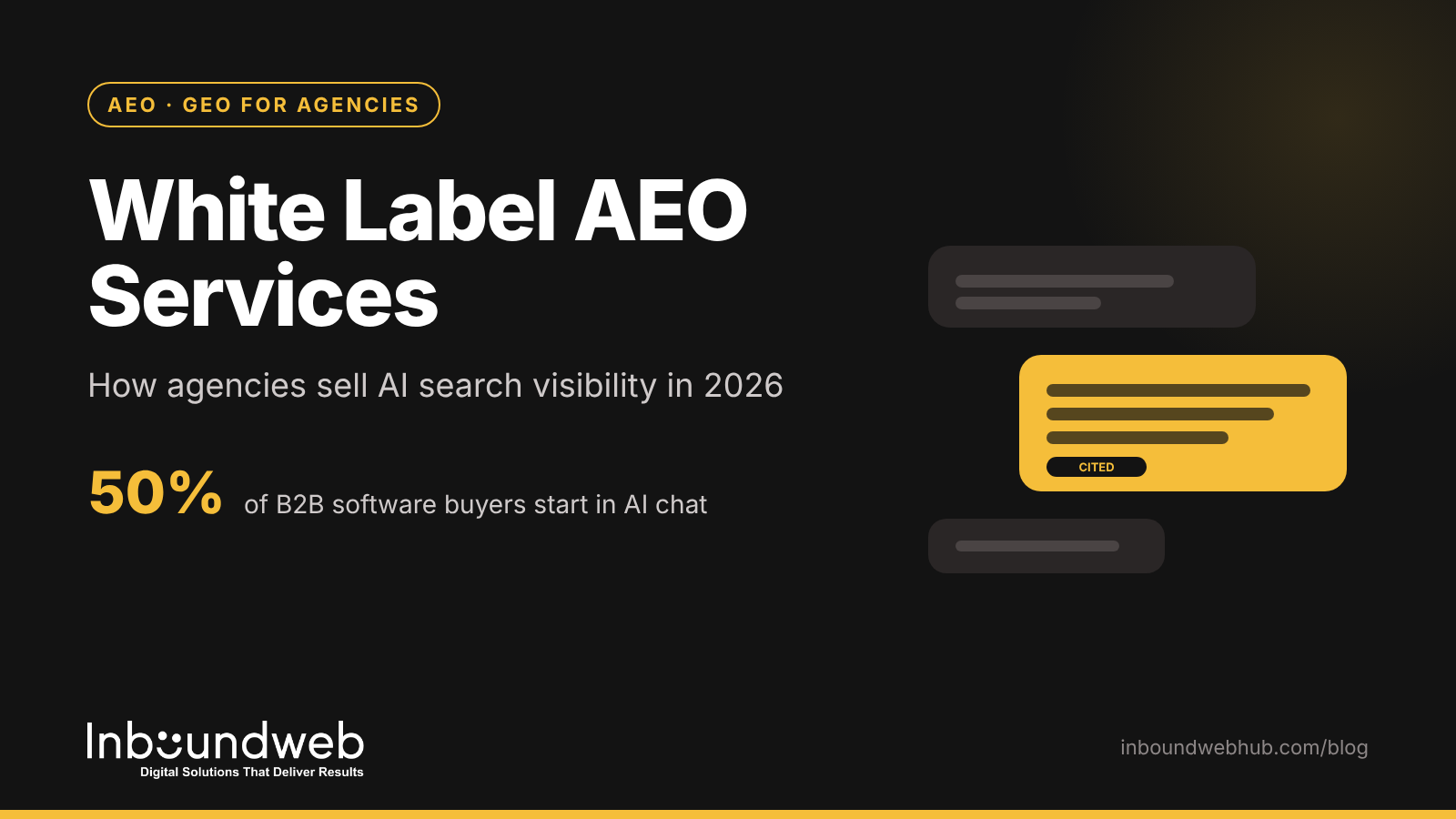
Clients are already asking for it. Half of B2B software buyers now start their research in an AI chatbot rather than Google, according to a 2026 G2 buyer survey. When a prospect asks ChatGPT "who are the best HubSpot partners for SaaS," your client either appears in that answer or doesn't. This guide covers what white-label AEO includes, how to price and package it, and how to choose a delivery partner.
Key takeaways
- AEO, GEO and SEO overlap but measure different things: rankings and clicks for SEO, citations and brand mentions in AI answers for AEO and GEO.
- Typical 2026 pricing: $1,500–$5,000 for an audit; $1,000–$3,500 a month entry level, $4,000–$12,000 for mid-market retainers.
- What a white-label partner delivers: AI visibility audits, schema, answer-first content, entity cleanup, off-site citation work and branded monthly reports.
- Content that gets cited answers early, includes statistics and sources, and is updated at least quarterly.
- Start with an audit offer to existing SEO clients. It's the easiest upsell and shows the gap in numbers.
What is white-label AEO?
White-label AEO is answer engine optimization delivered by a specialist partner and resold by your agency under your own brand. The partner runs the audits, implements schema and content changes, and produces reports with your logo. Your client sees only your agency, while you keep the relationship, the strategy and the margin.
It works the same way as white-label SEO or web development: the contract and invoice stay with you, and the partner is a cost line, not a competitor. If you've used a white-label partner for builds, the model is familiar. See our guide to white-label web development for agencies.
AEO vs GEO vs SEO: what's the difference?
SEO optimizes pages to rank and earn clicks in search results. AEO optimizes content so answer engines can lift a direct answer from it. GEO (generative engine optimization) works on how AI models describe and recommend a brand across many sources. In practice, agencies sell AEO and GEO together because the work overlaps.
| SEO | AEO | GEO |
|---|
| Goal | Rank pages and win clicks | Be the quoted answer | Be the recommended brand |
| Where it shows | Google and Bing results | AI Overviews, featured snippets, voice and chat answers | ChatGPT, Perplexity, Gemini, Claude, Copilot |
| Main levers | Keywords, links, technical health | Answer-first structure, FAQ and schema, freshness | Entity consistency, third-party mentions, citations, reviews |
| Key metrics | Rankings, organic traffic | Answer inclusion, snippet share | Citation rate, share of AI voice, AI referral traffic |
We break down each discipline on our AEO, GEO and SEO service pages.
Why are clients asking agencies for AEO now?
Clients want AEO because buyers increasingly research in AI tools and see fewer classic search results. About a quarter of Google searches now trigger an AI Overview, and ChatGPT drives about 87% of AI referral traffic, per Conductor's 2026 benchmarks. Brands that aren't cited in those answers lose visibility even when their rankings hold.
- Buyers start in chat. 50% of B2B software buyers begin in an AI chatbot, and 74% of those use ChatGPT (G2, 2026).
- AI is in almost every deal. 89% of B2B buyers used generative AI in at least one phase of their purchase (Forrester, 2024).
- Third parties matter. Brands are 6.5× more likely to be mentioned through third-party sources than their own site (AirOps, 2025).
Statistics compiled by Elite Content Marketer's 2026 GEO and AEO statistics roundup.
What does a white-label AEO service include?
A complete white-label AEO service includes an AI visibility audit, technical fixes such as schema and crawler access, answer-first content, entity cleanup across the web, off-site citation building and branded monthly reporting. The partner does the work; your agency owns strategy and the client conversation.
- AI visibility audit. Test 30–100 buyer prompts across ChatGPT, Perplexity, Gemini and AI Overviews. Record where the client and competitors are named and cited.
- Technical foundation. Article, FAQPage, Organization, Product and BreadcrumbList schema; crawler access in robots.txt; an llms.txt file; fast, crawlable pages.
- Answer-first content. Rewrite key pages and publish new posts that answer each target question in the first 40–60 words, with stats, sources and a table.
- Entity consistency. Align company facts, founding date, services and leadership across the website, LinkedIn, Google Business Profile, Clutch, G2 and directories.
- Off-site citations. Get listed in the "best of" articles, comparison pages, communities and review sites that AI engines already cite for the category.
- Reporting. Monthly citation rate, prompt coverage, share of AI voice versus competitors, and AI-referred traffic and leads, all on your branded template.
What gets cited: GEO-BENCH tests found adding statistics, quotations and source citations improved AI visibility by up to 41%. Pages updated within three months earn about 6 ChatGPT citations versus 3.6 for stale pages (SE Ranking, 2025).
How much should agencies charge for AEO?
Agencies typically charge $1,500–$5,000 for a one-time AEO audit and $1,000–$12,000 a month for ongoing AEO and GEO retainers in 2026, depending on client size and content volume. Enterprise and regulated-industry programmes start around $15,000 a month.
| Package | Typical client price (USD) | Typical client | What's included |
|---|
| AI visibility audit | $1,500–$5,000 one-time | Any existing SEO client | Prompt testing, competitor citations, schema gaps, prioritised roadmap |
| Starter retainer | $1,000–$3,500/month | Small B2B firms, local brands | Schema, 2–4 answer-first pieces, monthly citation report |
| Growth retainer | $4,000–$12,000/month | B2B SaaS and ecommerce with an SEO programme | Content engine, entity cleanup, off-site citation work, pipeline reporting |
| Enterprise | $15,000+/month | Global, regulated or multi-brand companies | Dedicated specialists, global schema architecture, digital PR |
Market ranges from 310 Creative's 2026 AEO agency pricing guide (updated August 2026). Price the outcome, not the hours, and keep the partner's cost below 50% of the retainer so your margin survives reporting and client calls.
How to package AEO for your existing clients
The easiest way to launch AEO is as an add-on to existing SEO or content retainers, starting with a paid audit. The audit shows the client exactly which prompts competitors win, which turns a vague "AI search" conversation into a concrete gap they'll pay to close.
- Pick 10 pilot clients with active SEO retainers and decent content libraries.
- Run audits on 30–50 buyer prompts each, showing a share-of-voice chart versus three competitors.
- Offer a 90-day sprint covering schema, 6–10 answer-first pages and entity cleanup.
- Convert to a retainer with monthly citation reporting once the first gains show.
How to choose a white-label AEO partner
Choose a white-label AEO partner that can show its own AI visibility, explain its prompt-testing method, implement schema on your clients' platforms, and report under your brand. Also check that it can actually edit the CMS your clients use, because most AEO fixes happen on the website.
- Proof on its own brand. Ask which prompts the partner is cited for in ChatGPT and Perplexity.
- A repeatable method. A documented prompt set, testing cadence and scoring model.
- Platform skills. Hands-on HubSpot CMS, Webflow, WordPress and Shopify implementation, not just recommendations.
- White-label hygiene. NDA, no-poach, unbranded deliverables and your report template.
- Honest claims. No partner can guarantee citations. Walk away from anyone who promises "#1 in ChatGPT."
How Inbound WebHub delivers white-label AEO
Inbound WebHub delivers AEO, GEO and SEO for agencies under their brand, backed by 1,100+ projects since 2017 and platform teams for HubSpot, Webflow, WordPress and Shopify. That means we can fix schema, rewrite pages and publish content directly in your client's CMS, not just send a report. Explore our AEO services, read how agencies scale with a white-label partner, or talk to us about a pilot audit.
Free downloads: AEO playbook and white-label toolkit
Want to put this into practice? Both guides are free, branded PDFs you can use with your team or adapt for client work.
FAQ
What does white-label AEO mean?
It's answer engine optimization delivered by a partner and resold by your agency under your brand. The partner does the audits, schema, content and reporting; your client only sees your agency.
Is AEO different from SEO?
Yes. SEO aims to rank pages and win clicks. AEO aims to have AI engines quote your content as the answer. Strong SEO helps, but AEO adds answer-first structure, schema, freshness and third-party citations.
How much do agencies charge for AEO services?
Typical 2026 pricing is $1,500–$5,000 for an audit and $1,000–$12,000 a month for retainers, with enterprise programmes from about $15,000 a month.
How long does AEO take to show results?
Technical fixes and refreshed pages can start appearing in AI answers within weeks of being crawled, but consistent citation gains usually take 3–6 months of content and off-site work.
Can a partner guarantee my client appears in ChatGPT?
No. AI answers vary by prompt, user and model version, so no one can guarantee placement. A good partner commits to a method, a prompt set and transparent reporting instead.