


Inbound Logo
Web Development
Resources
Free audit
Free HubSpot Portal Audit
Get an instant audit of your HubSpot portal with actionable insights to improve CRM setup, automation, marketing, and overall performance.
Start Free Audit
button arrowbutton arrow
Website Redesign

Website Redesign Guide: Increase Conversions Without Losing SEO in 2026

time
12 MIN
date
January 12, 2026
Website Redesign Guide: Increase Conversions Without Losing SEO in 2026
In this article

Most website redesign projects are disasters disguised as milestones. The brand-new site launches. Everyone cheers. Six weeks later organic traffic is down 35%, qualified demo requests are down 20%, and the CMO is explaining to the CEO why a £80k investment made the numbers worse.This guide is written for marketing leaders, founders, and heads of growth who are planning a redesign in the next 6–12 months. It covers the exact process for redesigning without tanking SEO, what actually drives conversion lift, how to structure the project, and where most redesigns silently destroy value. Written from a hundred-plus agency redesigns for UK and USA B2B brands, SaaS companies, and ecommerce stores.

What a Website Redesign Actually Is

A redesign is not a reskin. Changing colours, fonts, and hero images is a refresh — 4–6 weeks of work, low risk. A real website redesign rebuilds:

  • Information architecture (sitemap, navigation, page hierarchy)
  • Positioning and messaging
  • Visual design system
  • Technical platform (sometimes)
  • Conversion architecture (CTAs, forms, funnels)
  • SEO structure (URLs, metadata, schema, internal linking)

Refresh if your brand is fine and your numbers are fine. Redesign if the site is actively holding growth back — which, for most companies older than three years, it is.

Why Website Redesign Matters in 2026

1. Design expectations shifted fast. Sites that looked modern in 2022 look tired in 2026. Buyers equate dated design with dated product. If your homepage screams "last refreshed during COVID," you're losing trust before you open your mouth.2. Core Web Vitals became a conversion and ranking issue simultaneously. Slow sites lose rankings AND conversion. A redesign is the only real moment to fix structural performance debt.3. Messaging drift is real. Three years of product evolution, new personas, new competitors. If the site still describes the company the way it was in 2022, the redesign is as much a positioning project as a design project.Deciding whether you need one? Read 9 clear signals you need a redesign. Planning budget? See website redesign cost 2026.

How a Website Redesign Works (The Process That Doesn't Tank SEO)

There are six phases. Skip any of them and you either lose rankings or lose conversion. Often both.

1. Audit

Three parallel audits: SEO (rankings, traffic, top pages, backlinks), conversion (form performance, CTA click-through, funnel drop-off), and brand (positioning, message clarity, design coherence). Output: a findings document that becomes the brief.

2. Strategy

Positioning, ICP, message hierarchy, value prop articulation. No design starts until this is signed off. Skipping this step is the #1 cause of redesigns that don't convert.

3. Information Architecture

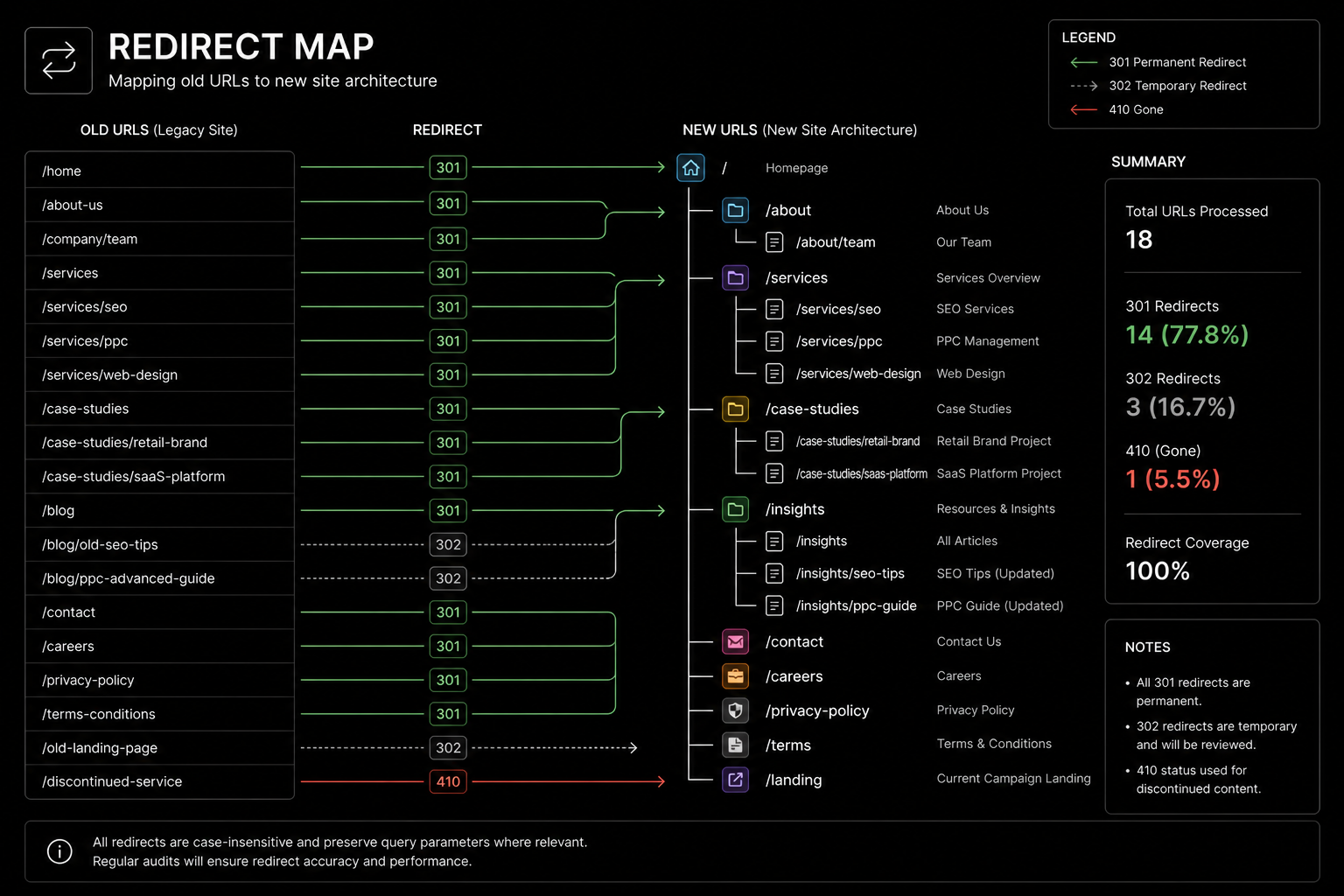
New sitemap. URL structure. Internal linking plan. Redirect map starts here. This is where SEO is won or lost on a redesign.

4. Design

Wireframes → high-fidelity. Design system. Component library. Mobile-first.

5. Build

Platform-specific. Could be Webflow,  HubSpot, WordPress, custom. Strong dev team implements the design system, CMS, integrations, and SEO technical requirements.

6. Launch & Migration

301 redirect map deployed. Search Console submission. Monitoring for 60 days post-launch. Traffic dip recovery plan.

Step-by-Step: The Redesign Checklist That Protects SEO

1. Full URL inventory. Every URL currently indexed. Every URL getting backlinks. Every URL driving organic traffic. Export from Screaming Frog, Ahrefs, and Search Console.2. Page-level traffic + ranking report. Which pages drive traffic? Which rank for valuable keywords? Which have backlinks? Prioritise these for content parity or better.3. 301 redirect map. Every old URL → new URL, one-to-one where possible. Never 302. Never chain redirects. Avoid redirecting high-value pages to the homepage — always pick the closest topical match.4. Content parity check. Every page that drives traffic must exist on the new site with equivalent or better content. Cut a top-traffic page only if you have a better replacement and you redirect correctly.5. Technical SEO audit on staging. Meta titles, descriptions, canonicals, schema, hreflang (if international), sitemap, robots.txt. Fix before launch, not after.6. Core Web Vitals on staging. LCP, INP, CLS — all green on mobile before launch.7. Search Console + Analytics ready. New property added, sitemap pre-submitted, GA4 events mapped to new page structure.8. Launch plan. Ideally Tuesday or Wednesday, off-peak. Full team on standby for 48 hours. Monitor rankings, crawl errors, 404s.9. 60-day monitoring. Rankings will dip 2–4 weeks in. That's normal. Major drops (>20%) need intervention — usually a missing redirect or a schema break.

Planning a redesign in the next two quarters? Our team has run redesigns for UK and USA B2B brands without losing organic traffic. See our redesign process or book a free 45-minute redesign discovery call — we'll tell you what your risk areas are and what realistic scope looks like.

Best Tools and Platforms for Website Redesign in 2026

  • Screaming Frog — URL inventory, redirect audits, pre-launch technical checks.
  • Ahrefs or Semrush — Backlink inventory, ranking tracking, content gap analysis.
  • Google Search Console — Pre-launch and post-launch monitoring.
  • Figma — Design, design system, component library.
  • Webflow / HubSpot / Framer / WordPress — Platform choice dictated by business stage. See our Webflow vs WordPress and HubSpot vs WordPress breakdowns.
  • Hotjar or Microsoft Clarity — Pre-redesign user behaviour audit, post-launch validation.
  • PageSpeed Insights + Lighthouse — Core Web Vitals monitoring.

Common Website Redesign Mistakes

1. Starting design before strategy. Beautiful site that says nothing compelling. Fix: positioning and message hierarchy locked before any Figma work.2. Killing old URLs without redirects. 40% organic traffic gone in two weeks. Fix: one-to-one 301 map, no exceptions.3. Changing URL structure for aesthetics. "We want cleaner URLs." Great, but every existing backlink now points to a 301 chain. Only restructure URLs if the SEO upside exceeds the link-equity cost.4. No conversion baseline. Launch day, nobody knows what conversion was before. Impossible to prove the redesign worked. Fix: 30-day pre-launch conversion snapshot, documented.5. Treating the launch as the finish line. Redesign is 70% of the project. The other 30% is post-launch conversion rate optimization — iterative testing, funnel tuning, content expansion. Brands that skip this see the redesign plateau and blame the design.

FAQ

How long does a website redesign take?

8–16 weeks for a marketing site depending on platform, content volume, and integrations. Enterprise redesigns with migrations and localisation run 4–6 months.

Will a redesign hurt my SEO?

Only if done badly. With a proper redirect map, content parity, and technical SEO audit, most sites recover pre-launch traffic within 60–90 days and often exceed it. Our website redesign team treats SEO preservation as a first-class requirement, not an afterthought.

How much does a redesign cost?

£15–35k / $20–45k for a growth-stage SaaS marketing site. £40–120k for a B2B brand with complex IA, content migration, and integrations. Full breakdown in website redesign cost 2026.

Should I change platforms during the redesign?

Sometimes, yes — if the current platform is actively blocking speed or team velocity. But platform migration doubles project risk. If the platform's fine, don't.

How do I measure redesign success?

Three metrics: organic traffic (90-day post vs 90-day pre), demo requests or qualified leads (same), page-level conversion rate on 3–5 core pages. Anything else is vanity.

Can I do the redesign in-house?

If you have a senior designer, a senior developer, an SEO lead, and a PM with redesign experience — yes. Most mid-market companies don't. A specialist redesign agency is usually faster and cheaper once the opportunity cost of internal time is counted.

Conclusion: Redesign as a Growth Investment, Not a Refresh

A website redesign done right returns multiples. Done badly, it sets you back a year. The difference is almost always process — not design talent, not platform choice, not budget. Teams that respect SEO preservation, lock strategy before design, and invest in post-launch CRO win. Teams that treat redesign as "make it pretty" lose.If you're planning a redesign, the single best thing you can do before signing any agency is a structured discovery conversation with someone who's run this process at least 20 times.Our website redesign team has shipped redesigns for SaaS, B2B, and ecommerce brands across the UK and USA. Book a free 45-minute redesign discovery call — we'll review your current site and map realistic scope, timeline, and risk areas.

The SEO-Safe Redesign Checklist — 58-point checklist we run before every client launch, covering URL inventory, redirect mapping, schema, Core Web Vitals, and monitoring.

KEEP BUILDING
title arrow

You've got the plan. Let's build it.

We turn the frameworks you just read into the flows, pages, and automation behind them — under your brand, always.

Keep reading

View all articles
button arrowbutton arrow
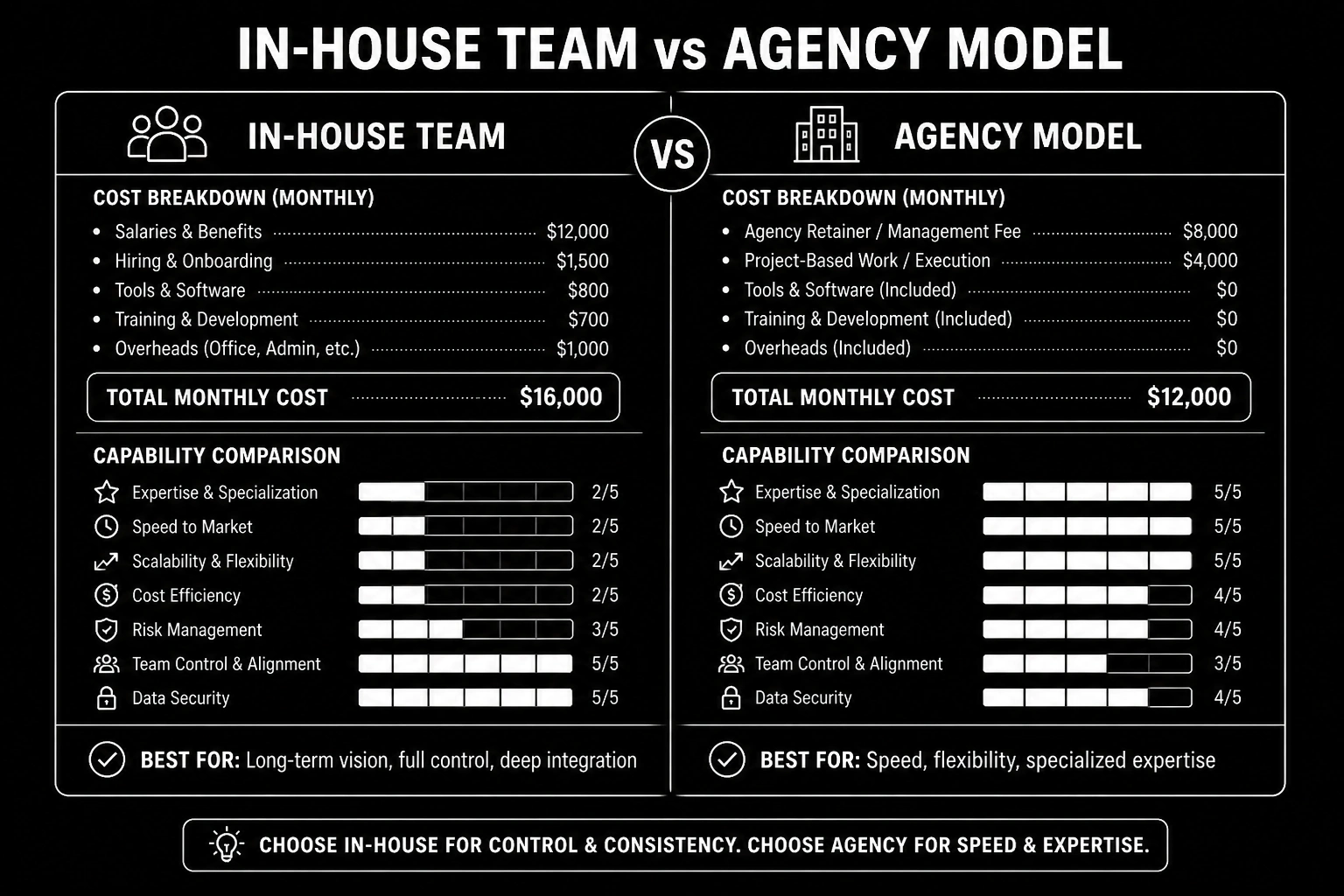
Outsource Web Design vs In-House: What Actually Scales
Agency
Website Redesign

Outsource Web Design vs In-House: What Actually Scales

Outsource Web Design vs In-House in 2026 is won by execution quality, not platform hype. Teams that perform consistently align strategy, implementation, and measurement into one operating system. This guide gives the practical framework, internal link map, and optimization cadence to do that.The in-house vs agency debate is settled — for the wrong reasons. Here's the honest 2026 cost and quality comparison. If you want implementation help, work with get a custom quote. For connected strategy, also review White Label Web Development and Best Webflow Agencies Saas.

What Outsource Web Design vs In-House Means in Practice

Outsource web design vs in-house is a stage and operating-model decision. The best choice balances speed, quality, management capacity, and strategic control.

Why outsource web design Matters in 2026

1. Hiring in-house is slower when roadmap demand is uneven.2. Specialist partners can accelerate output with proper governance.3. Hourly-rate comparisons miss hidden management costs.

Step-by-Step Playbook

1. Define capability needs

List critical skills required for the next 12 months.

2. Model true cost scenarios

Compare FTE, tooling, management load, and output speed.

3. Assess control requirements

Decide what must stay internal vs external.

4. Run a pilot project

Validate quality and communication before long commitments.

5. Install governance cadence

Use weekly reviews and KPI visibility in either model.Mid-article CTA -> Need support applying this to your stack? Build vs buy call and get a scoped roadmap with timeline, owners, and KPI targets.

Tools, References, and Benchmarks

  • Build-vs-buy calculator
  • Capability gap matrix
  • Vendor governance template
  • Semantic keyword targets to distribute naturally: in-house vs agency design, outsource design team, hire agency vs in-house

Use these references during planning and QA: HBR strategy resources, McKinsey growth insights, and Gartner business insights.

Common Mistakes That Kill Performance

  • Comparing rates only
  • Skipping pilot validation
  • No governance after kickoff

FAQ - Outsource Web Design vs In-House

How long does a outsource web design project usually take?

Most teams can ship an initial version in 4 to 8 weeks, then improve outcomes over one quarter with a weekly optimization cadence.

Is outsource web design relevant for UK and US teams?

Yes. The core framework is consistent across both markets. Differences are usually compliance details, buying behavior, and GBP/USD planning.

What should we measure first for outsource web design?

Track one leading metric, one conversion metric, and one revenue metric so execution stays tied to business impact.

Should we run this in-house or with a specialist partner?

If your team has deep expertise and bandwidth, in-house can work. If speed and risk control matter, working with a specialist partner is usually faster.

What is the most common failure mode?

Teams skip governance after launch. Data quality drifts, process quality declines, and performance plateaus. A simple weekly operating rhythm prevents this.

Conclusion

Outsource Web Design vs In-House performs best when execution decisions are tied to measurable outcomes from day one. Use this playbook to prioritize what matters, reduce risk, and create a repeatable optimization rhythm.Want a specialist team to accelerate delivery? Talk to get a custom quote or book a consultation and we will map a practical rollout plan.Download the In-House vs Agency Decision Guide to implement this framework with templates and checklists.

The In-House vs Agency Decision Guide — cost comparison worksheet, capability gap matrix, vendor evaluation scorecard, project governance template, pilot project checklist, 30/60/90-day rollout plan, and KPI dashboard to help you choose the right web design delivery model.

B2B Website Redesign Checklist: 41 Items That Protect Pipeline
Website Redesign

B2B Website Redesign Checklist: 41 Items That Protect Pipeline

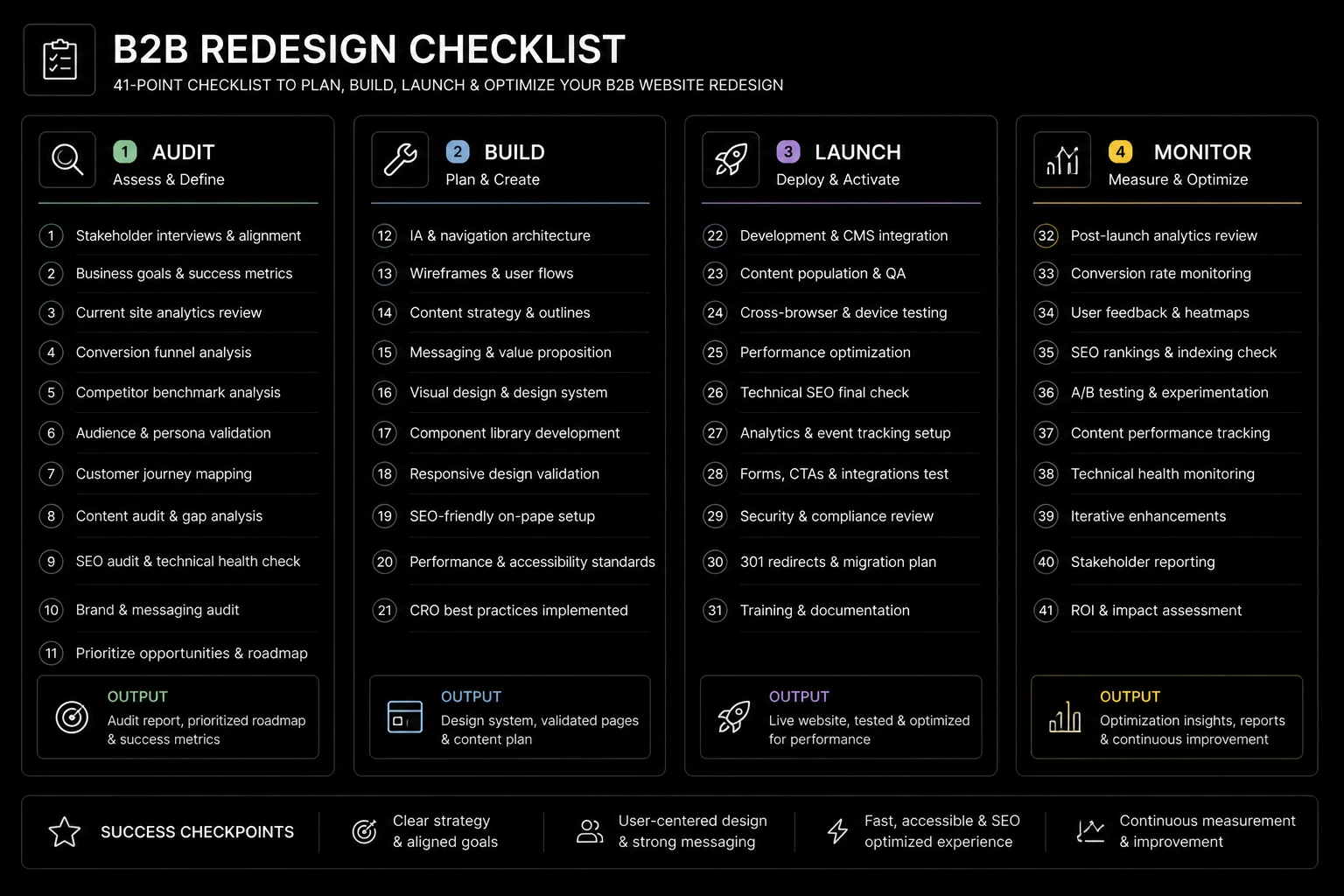
B2B Website Redesign Checklist in 2026 is won by execution quality, not platform hype. Teams that perform consistently align strategy, implementation, and measurement into one operating system. This guide gives the practical framework, internal link map, and optimization cadence to do that.Half of B2B redesigns drop pipeline within 90 days of launch. This 41-point checklist prevents that. If you want implementation help, work with B2B redesign specialists. For connected strategy, also review Website Redesign Guide and Website Redesign Cost. You can also align execution with book a free consultation for cross-functional delivery.

What B2B Website Redesign Checklist Means in Practice

A B2B website redesign checklist protects pipeline by sequencing messaging, SEO, and conversion decisions before visual implementation. Most redesign failures are migration and measurement failures, not design failures.

Why b2b website redesign Matters in 2026

1. Redesign risk is often underestimated until after launch.2. Leadership expects pipeline impact, not only visual refresh.3. Traffic volatility can be controlled with technical planning.

Step-by-Step Playbook

1. Capture baseline metrics

Record rankings, conversion rate, and pipeline influence pre-redesign.

2. Lock positioning and IA

Finalize messaging and page intent before high-fidelity design.

3. Build redirect plan early

Map legacy URLs and preserve authority-critical routes.

4. QA conversion journeys

Test forms, events, and CRM integrations before launch.

5. Run 90-day monitoring

Track rankings and lead quality weekly after release.Mid-article CTA -> Need support applying this to your stack? B2B redesign call and get a scoped roadmap with timeline, owners, and KPI targets.

Redirect map

Tools, References, and Benchmarks

  • 41-point redesign checklist
  • Redirect map workbook
  • Post-launch KPI dashboard
  • Semantic keyword targets to distribute naturally: b2b website redesign checklist, saas website redesign, b2b website refresh

Use these references during planning and QA: Google site migration guide, web.dev Core Web Vitals guidance, and Screaming Frog documentation.

Common Mistakes That Kill Performance

  • Treating redesign as brand-only work
  • Late redirect planning
  • No post-launch accountability

FAQ - B2B Website Redesign Checklist

How long does a b2b website redesign project usually take?

Most teams can ship an initial version in 4 to 8 weeks, then improve outcomes over one quarter with a weekly optimization cadence.

Is b2b website redesign relevant for UK and US teams?

Yes. The core framework is consistent across both markets. Differences are usually compliance details, buying behavior, and GBP/USD planning.

What should we measure first for b2b website redesign?

Track one leading metric, one conversion metric, and one revenue metric so execution stays tied to business impact.

Should we run this in-house or with a specialist partner?

If your team has deep expertise and bandwidth, in-house can work. If speed and risk control matter, working with a specialist partner is usually faster.

What is the most common failure mode?

Teams skip governance after launch. Data quality drifts, process quality declines, and performance plateaus. A simple weekly operating rhythm prevents this.

Conclusion

B2B Website Redesign Checklist performs best when execution decisions are tied to measurable outcomes from day one. Use this playbook to prioritize what matters, reduce risk, and create a repeatable optimization rhythm.Want a specialist team to accelerate delivery? Talk to B2B redesign specialists or book a consultation and we will map a practical rollout plan.Download the B2B Redesign Pipeline Protection Checklist to implement this framework with templates and checklists.

B2B Redesign Pipeline Protection Checklist — A complete redesign toolkit with a 41-point launch checklist, SEO migration plan, redirect workbook, QA templates, KPI dashboards, and post-launch monitoring framework to protect traffic, leads, and pipeline.

When Should You Redesign Your Website? 9 Clear Signals
Website Redesign

When Should You Redesign Your Website? 9 Clear Signals

Most companies wait too long to redesign. They know the site is tired, but they're not sure if the time is now or later. Result: six more months of lost traffic, low conversions, and executive frustration that could have been avoided with a decision framework.This guide covers the 9 clear signals that a redesign is overdue, the framework to choose between refresh vs redesign vs rebuild, and how to prioritise redesign in your roadmap.

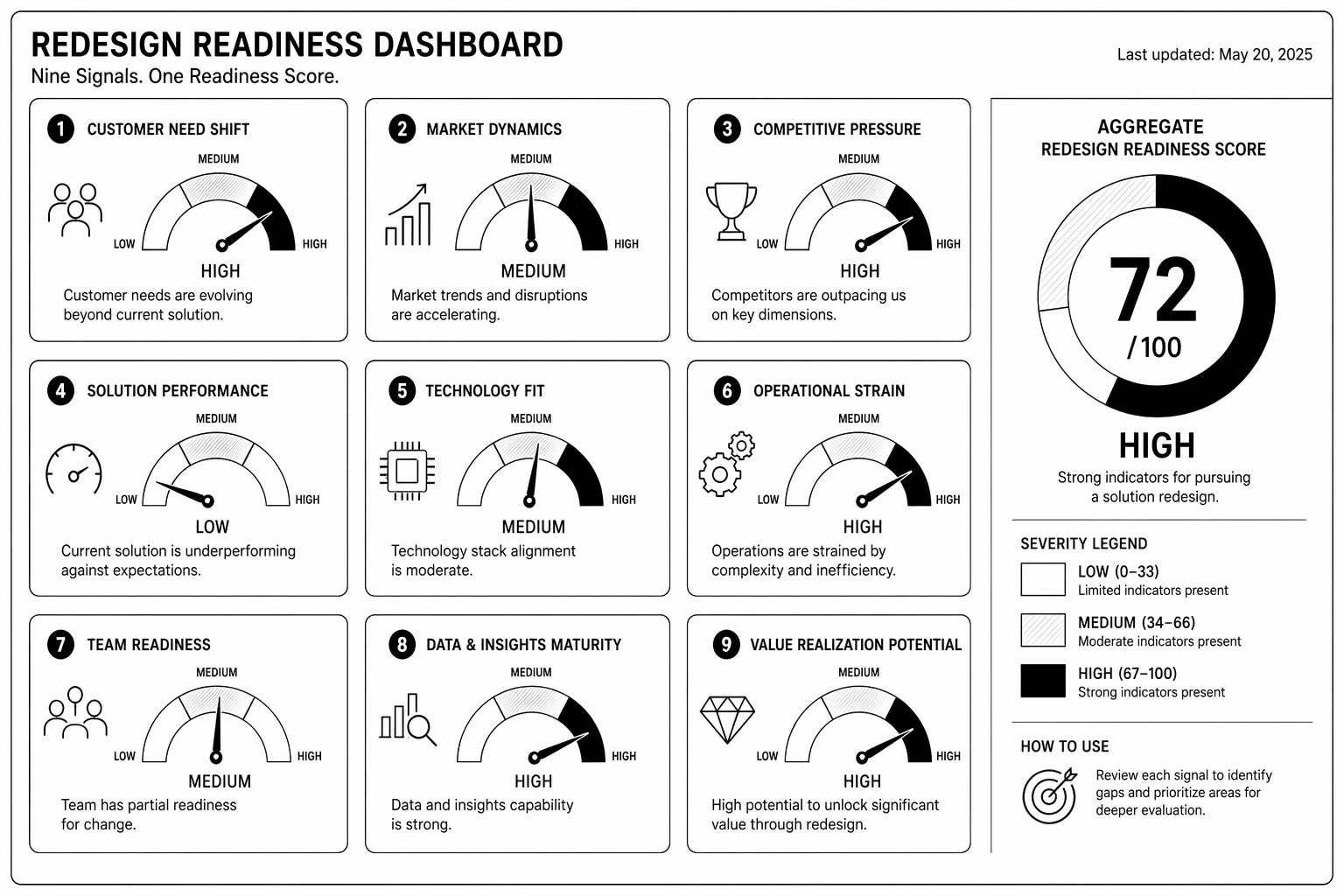
The 9 Signals Your Website Needs a Redesign

1. Organic traffic has plateaued or declined for 6+ months. If traffic isn't growing despite increased content and backlinks, the site itself may be the ceiling. Sites over three years old often need architecture refresh.2. Core Web Vitals are red (especially INP or CLS). Your site is slow, janky, or unstable on mobile. Google sees it, so do visitors. Redesign is the reset button.3. Conversion rate is 30%+ below your category benchmark. If demo request rate or lead conversion is substantially worse than competitors, messaging, design, or tech architecture is wrong.4. Bounce rate is above 60% on key pages. Visitors land, see outdated design or unclear value prop, leave immediately. Redesign won't fix bad positioning, but it removes design as the objection.5. Mobile conversion is 50%+ lower than desktop. Site wasn't designed mobile-first. Responsive fix is a patch. True mobile optimization requires redesign.6. Design no longer matches current brand or product. Last redesign was 3–4 years ago. Brand has evolved. Site looks like an old company.7. Marketing team says "we can't get anything shipped." CMS is slow, editing is painful, approval workflows are broken. Operations problem, usually solved by platform migration.8. You've added so many feature requests the site feels bloated. Homepage is 5,000px long. Navigation has 40+ items. Information architecture broke under weight of feature creep.9. Support team logs 20+ tickets/month about the site. UX confusion, forms breaking, checkout issues. Users are telling you the site is broken before analytics do.

Refresh vs Redesign vs Rebuild: The Decision Framework

Refresh (4–8 weeks, £5k–20k):

  • Brand colours, fonts, imagery updated.
  • Same CMS, same platform, same IA.
  • No structural changes.
  • Choose this if: Brand is tired but strategy is sound. Content performs well. No major platform complaints.

Redesign (10–16 weeks, £20k–60k):

  • New visual design + IA rethink + CMS optimisation.
  • Same platform (usually) but restructured content.
  • CRO-focused changes.
  • Choose this if: Signals 1–5 above are present. Information architecture is broken but strategy is sound.

Rebuild (16–24 weeks, £60k–150k+):

  • New platform entirely or complete technical rewrite.
  • New strategy, new positioning, new IA.
  • Everything changes.
  • Choose this if: Platform is actively hurting growth. Multiple signals present. Need major strategic reset.
Redesign Readiness dashboard

Timing: When to Start Planning

Start planning immediately if: 3+ signals are present. Planning takes 4–8 weeks. You want the redesign live before your busiest season.Start planning within 90 days if: 1–2 signals are present but trending worse. Monitor. If it gets to 3, accelerate.Wait if: No signals present, site is performing well, team is happy. Don't redesign for the sake of redesign.

Unsure if your site needs a redesign? Our team runs free 30-minute readiness assessments. Book one and we'll tell you honestly whether refresh, redesign, or rebuild is right.

Common Mistakes When Deciding to Redesign

1. Redesigning without understanding why traffic slowed. Redesign is a potential solution, not the solution. Audit first.2. "Let's refresh the design" when the problem is information architecture. Pretty site with bad IA still doesn't convert.3. Redesigning too often. Every two years is expensive and demoralising. Every four years is standard. Refresh between redesigns.4. Redesigning during peak season. Launch during slow periods. January, April, September are safer than Black Friday or product launch season.5. No baseline metrics before redesign. You won't know if it worked. Capture traffic, conversions, and performance before launch.For the actual redesign process, see our complete redesign guide to protect SEO and execution quality.

FAQ

How often should I redesign my website?

Every 3–4 years for major redesigns. Refresh between redesigns annually or every two years. Continuous small iterations always beat big periodic overhauls.

Should I redesign during growth season?

No. Launch during off-season (Q1 or Q3 for most B2B). You need 4–6 weeks post-launch to monitor and fix issues without impacting revenue.

Can I redesign gradually or do I need a hard cutover?

Hard cutover is cleaner SEO-wise. Gradual rollouts are messier redirect-wise. Pick one or the other, avoid in-between.

Will a redesign hurt my SEO?

Only with bad execution. Proper 301 redirects, content parity, and metadata preservation keep rankings intact. See the redesign SEO guide.

What's the simplest signal I should redesign?

If your site is over four years old and you haven't refreshed design or IA, that's reason enough. Design trends change. User expectations change. Your site should reflect current reality.

Conclusion: Redesign When Multiple Signals Align

Don't redesign on a hunch or trend alone. Use this signal framework. If 3+ signals are present, redesign is likely overdue. If 1–2 signals are present, monitor and plan for the next quarter.Start planning early. Launch during off-season. Measure baselines before and after. You'll know within 90 days if redesign was worth it.Our redesign team runs readiness audits and execution. Book a consultation if you're on the fence.

 The Redesign Readiness Self-Assessment — a worksheet to score your site against the 9 signals and get a clear recommendation.