


Inbound Logo
Web Development
Resources
Free audit
Free HubSpot Portal Audit
Get an instant audit of your HubSpot portal with actionable insights to improve CRM setup, automation, marketing, and overall performance.
Start Free Audit
button arrowbutton arrow
Website Redesign

When Should You Redesign Your Website? 9 Clear Signals

time
12 MIN
date
April 14, 2026
When Should You Redesign Your Website? 9 Clear Signals
In this article

Most companies wait too long to redesign. They know the site is tired, but they're not sure if the time is now or later. Result: six more months of lost traffic, low conversions, and executive frustration that could have been avoided with a decision framework.This guide covers the 9 clear signals that a redesign is overdue, the framework to choose between refresh vs redesign vs rebuild, and how to prioritise redesign in your roadmap.

The 9 Signals Your Website Needs a Redesign

1. Organic traffic has plateaued or declined for 6+ months. If traffic isn't growing despite increased content and backlinks, the site itself may be the ceiling. Sites over three years old often need architecture refresh.2. Core Web Vitals are red (especially INP or CLS). Your site is slow, janky, or unstable on mobile. Google sees it, so do visitors. Redesign is the reset button.3. Conversion rate is 30%+ below your category benchmark. If demo request rate or lead conversion is substantially worse than competitors, messaging, design, or tech architecture is wrong.4. Bounce rate is above 60% on key pages. Visitors land, see outdated design or unclear value prop, leave immediately. Redesign won't fix bad positioning, but it removes design as the objection.5. Mobile conversion is 50%+ lower than desktop. Site wasn't designed mobile-first. Responsive fix is a patch. True mobile optimization requires redesign.6. Design no longer matches current brand or product. Last redesign was 3–4 years ago. Brand has evolved. Site looks like an old company.7. Marketing team says "we can't get anything shipped." CMS is slow, editing is painful, approval workflows are broken. Operations problem, usually solved by platform migration.8. You've added so many feature requests the site feels bloated. Homepage is 5,000px long. Navigation has 40+ items. Information architecture broke under weight of feature creep.9. Support team logs 20+ tickets/month about the site. UX confusion, forms breaking, checkout issues. Users are telling you the site is broken before analytics do.

Refresh vs Redesign vs Rebuild: The Decision Framework

Refresh (4–8 weeks, £5k–20k):

  • Brand colours, fonts, imagery updated.
  • Same CMS, same platform, same IA.
  • No structural changes.
  • Choose this if: Brand is tired but strategy is sound. Content performs well. No major platform complaints.

Redesign (10–16 weeks, £20k–60k):

  • New visual design + IA rethink + CMS optimisation.
  • Same platform (usually) but restructured content.
  • CRO-focused changes.
  • Choose this if: Signals 1–5 above are present. Information architecture is broken but strategy is sound.

Rebuild (16–24 weeks, £60k–150k+):

  • New platform entirely or complete technical rewrite.
  • New strategy, new positioning, new IA.
  • Everything changes.
  • Choose this if: Platform is actively hurting growth. Multiple signals present. Need major strategic reset.
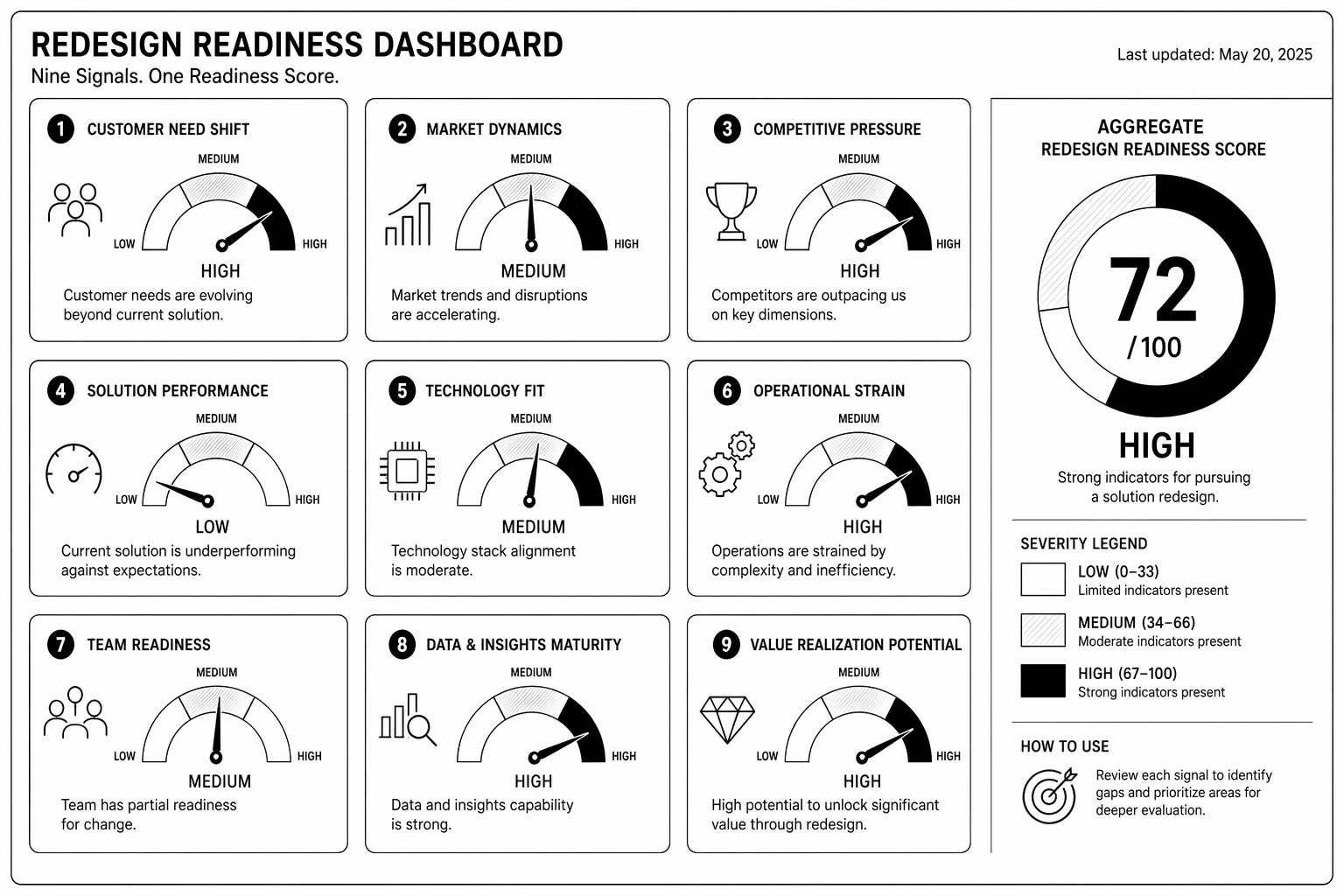
Redesign Readiness dashboard

Timing: When to Start Planning

Start planning immediately if: 3+ signals are present. Planning takes 4–8 weeks. You want the redesign live before your busiest season.Start planning within 90 days if: 1–2 signals are present but trending worse. Monitor. If it gets to 3, accelerate.Wait if: No signals present, site is performing well, team is happy. Don't redesign for the sake of redesign.

Unsure if your site needs a redesign? Our team runs free 30-minute readiness assessments. Book one and we'll tell you honestly whether refresh, redesign, or rebuild is right.

Common Mistakes When Deciding to Redesign

1. Redesigning without understanding why traffic slowed. Redesign is a potential solution, not the solution. Audit first.2. "Let's refresh the design" when the problem is information architecture. Pretty site with bad IA still doesn't convert.3. Redesigning too often. Every two years is expensive and demoralising. Every four years is standard. Refresh between redesigns.4. Redesigning during peak season. Launch during slow periods. January, April, September are safer than Black Friday or product launch season.5. No baseline metrics before redesign. You won't know if it worked. Capture traffic, conversions, and performance before launch.For the actual redesign process, see our complete redesign guide to protect SEO and execution quality.

FAQ

How often should I redesign my website?

Every 3–4 years for major redesigns. Refresh between redesigns annually or every two years. Continuous small iterations always beat big periodic overhauls.

Should I redesign during growth season?

No. Launch during off-season (Q1 or Q3 for most B2B). You need 4–6 weeks post-launch to monitor and fix issues without impacting revenue.

Can I redesign gradually or do I need a hard cutover?

Hard cutover is cleaner SEO-wise. Gradual rollouts are messier redirect-wise. Pick one or the other, avoid in-between.

Will a redesign hurt my SEO?

Only with bad execution. Proper 301 redirects, content parity, and metadata preservation keep rankings intact. See the redesign SEO guide.

What's the simplest signal I should redesign?

If your site is over four years old and you haven't refreshed design or IA, that's reason enough. Design trends change. User expectations change. Your site should reflect current reality.

Conclusion: Redesign When Multiple Signals Align

Don't redesign on a hunch or trend alone. Use this signal framework. If 3+ signals are present, redesign is likely overdue. If 1–2 signals are present, monitor and plan for the next quarter.Start planning early. Launch during off-season. Measure baselines before and after. You'll know within 90 days if redesign was worth it.Our redesign team runs readiness audits and execution. Book a consultation if you're on the fence.

 The Redesign Readiness Self-Assessment — a worksheet to score your site against the 9 signals and get a clear recommendation.

KEEP BUILDING
title arrow

You've got the plan. Let's build it.

We turn the frameworks you just read into the flows, pages, and automation behind them — under your brand, always.

Keep reading

View all articles
button arrowbutton arrow
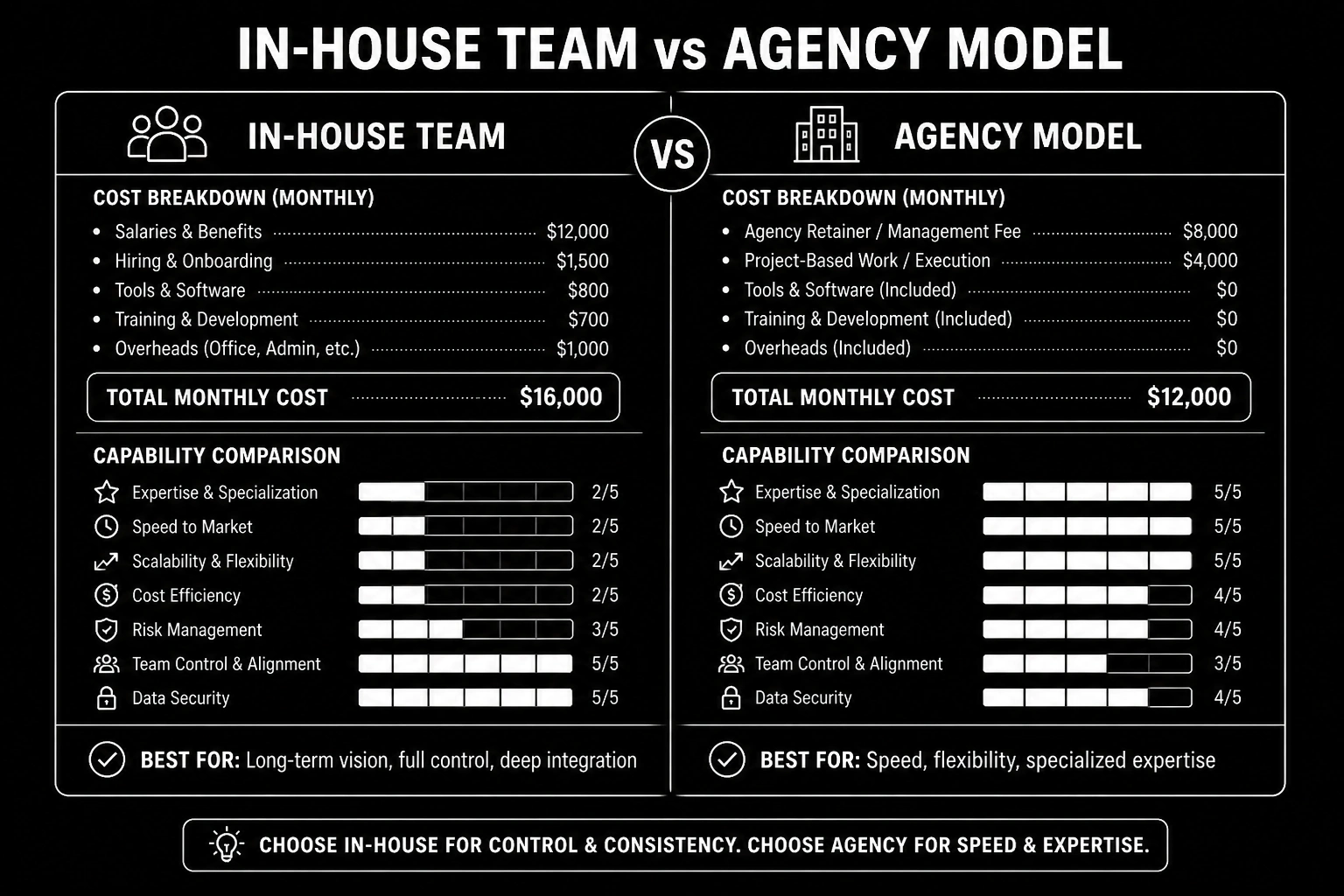
Outsource Web Design vs In-House: What Actually Scales
Agency
Website Redesign

Outsource Web Design vs In-House: What Actually Scales

Outsource Web Design vs In-House in 2026 is won by execution quality, not platform hype. Teams that perform consistently align strategy, implementation, and measurement into one operating system. This guide gives the practical framework, internal link map, and optimization cadence to do that.The in-house vs agency debate is settled — for the wrong reasons. Here's the honest 2026 cost and quality comparison. If you want implementation help, work with get a custom quote. For connected strategy, also review White Label Web Development and Best Webflow Agencies Saas.

What Outsource Web Design vs In-House Means in Practice

Outsource web design vs in-house is a stage and operating-model decision. The best choice balances speed, quality, management capacity, and strategic control.

Why outsource web design Matters in 2026

1. Hiring in-house is slower when roadmap demand is uneven.2. Specialist partners can accelerate output with proper governance.3. Hourly-rate comparisons miss hidden management costs.

Step-by-Step Playbook

1. Define capability needs

List critical skills required for the next 12 months.

2. Model true cost scenarios

Compare FTE, tooling, management load, and output speed.

3. Assess control requirements

Decide what must stay internal vs external.

4. Run a pilot project

Validate quality and communication before long commitments.

5. Install governance cadence

Use weekly reviews and KPI visibility in either model.Mid-article CTA -> Need support applying this to your stack? Build vs buy call and get a scoped roadmap with timeline, owners, and KPI targets.

Tools, References, and Benchmarks

  • Build-vs-buy calculator
  • Capability gap matrix
  • Vendor governance template
  • Semantic keyword targets to distribute naturally: in-house vs agency design, outsource design team, hire agency vs in-house

Use these references during planning and QA: HBR strategy resources, McKinsey growth insights, and Gartner business insights.

Common Mistakes That Kill Performance

  • Comparing rates only
  • Skipping pilot validation
  • No governance after kickoff

FAQ - Outsource Web Design vs In-House

How long does a outsource web design project usually take?

Most teams can ship an initial version in 4 to 8 weeks, then improve outcomes over one quarter with a weekly optimization cadence.

Is outsource web design relevant for UK and US teams?

Yes. The core framework is consistent across both markets. Differences are usually compliance details, buying behavior, and GBP/USD planning.

What should we measure first for outsource web design?

Track one leading metric, one conversion metric, and one revenue metric so execution stays tied to business impact.

Should we run this in-house or with a specialist partner?

If your team has deep expertise and bandwidth, in-house can work. If speed and risk control matter, working with a specialist partner is usually faster.

What is the most common failure mode?

Teams skip governance after launch. Data quality drifts, process quality declines, and performance plateaus. A simple weekly operating rhythm prevents this.

Conclusion

Outsource Web Design vs In-House performs best when execution decisions are tied to measurable outcomes from day one. Use this playbook to prioritize what matters, reduce risk, and create a repeatable optimization rhythm.Want a specialist team to accelerate delivery? Talk to get a custom quote or book a consultation and we will map a practical rollout plan.Download the In-House vs Agency Decision Guide to implement this framework with templates and checklists.

The In-House vs Agency Decision Guide — cost comparison worksheet, capability gap matrix, vendor evaluation scorecard, project governance template, pilot project checklist, 30/60/90-day rollout plan, and KPI dashboard to help you choose the right web design delivery model.

B2B Website Redesign Checklist: 41 Items That Protect Pipeline
Website Redesign

B2B Website Redesign Checklist: 41 Items That Protect Pipeline

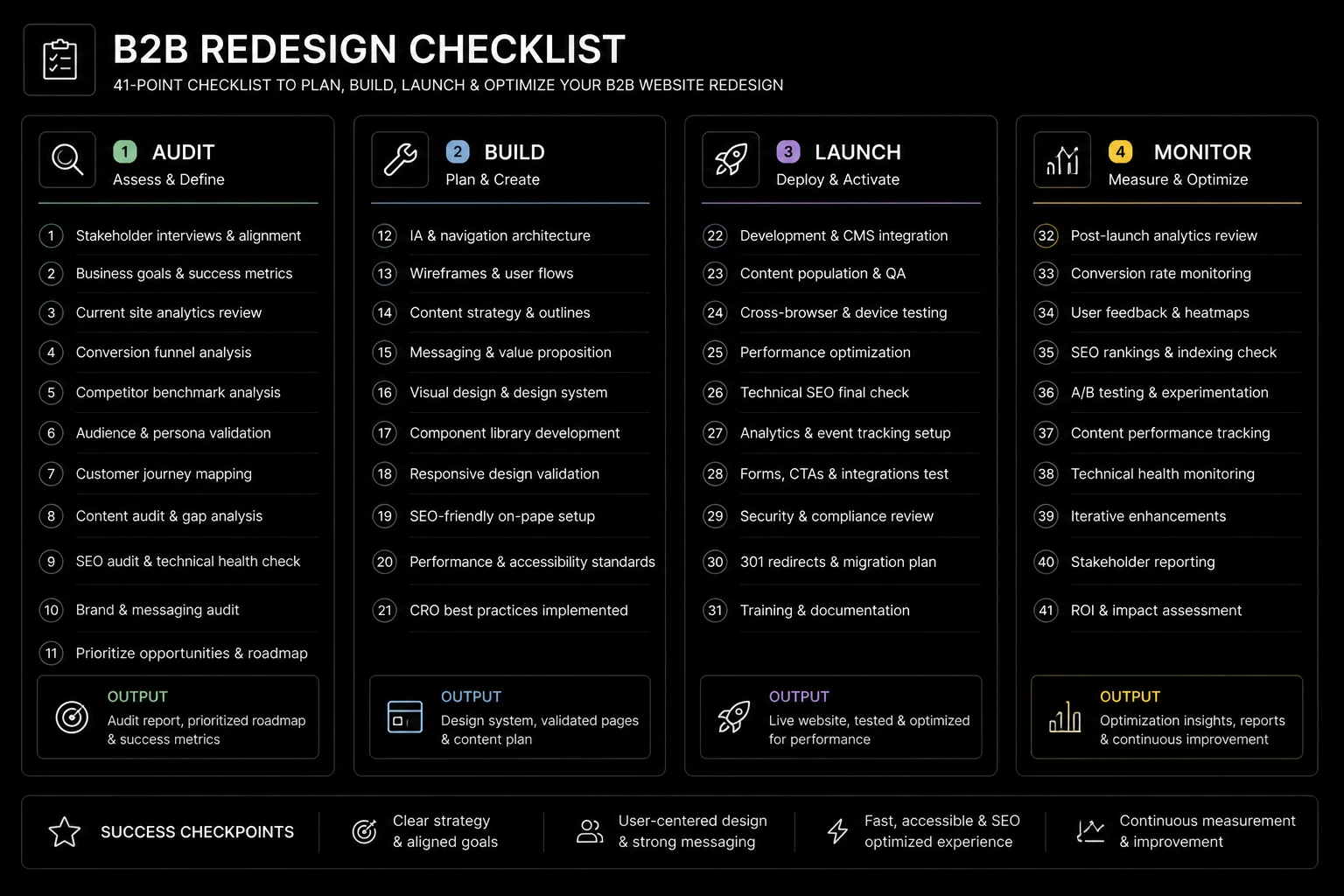
B2B Website Redesign Checklist in 2026 is won by execution quality, not platform hype. Teams that perform consistently align strategy, implementation, and measurement into one operating system. This guide gives the practical framework, internal link map, and optimization cadence to do that.Half of B2B redesigns drop pipeline within 90 days of launch. This 41-point checklist prevents that. If you want implementation help, work with B2B redesign specialists. For connected strategy, also review Website Redesign Guide and Website Redesign Cost. You can also align execution with book a free consultation for cross-functional delivery.

What B2B Website Redesign Checklist Means in Practice

A B2B website redesign checklist protects pipeline by sequencing messaging, SEO, and conversion decisions before visual implementation. Most redesign failures are migration and measurement failures, not design failures.

Why b2b website redesign Matters in 2026

1. Redesign risk is often underestimated until after launch.2. Leadership expects pipeline impact, not only visual refresh.3. Traffic volatility can be controlled with technical planning.

Step-by-Step Playbook

1. Capture baseline metrics

Record rankings, conversion rate, and pipeline influence pre-redesign.

2. Lock positioning and IA

Finalize messaging and page intent before high-fidelity design.

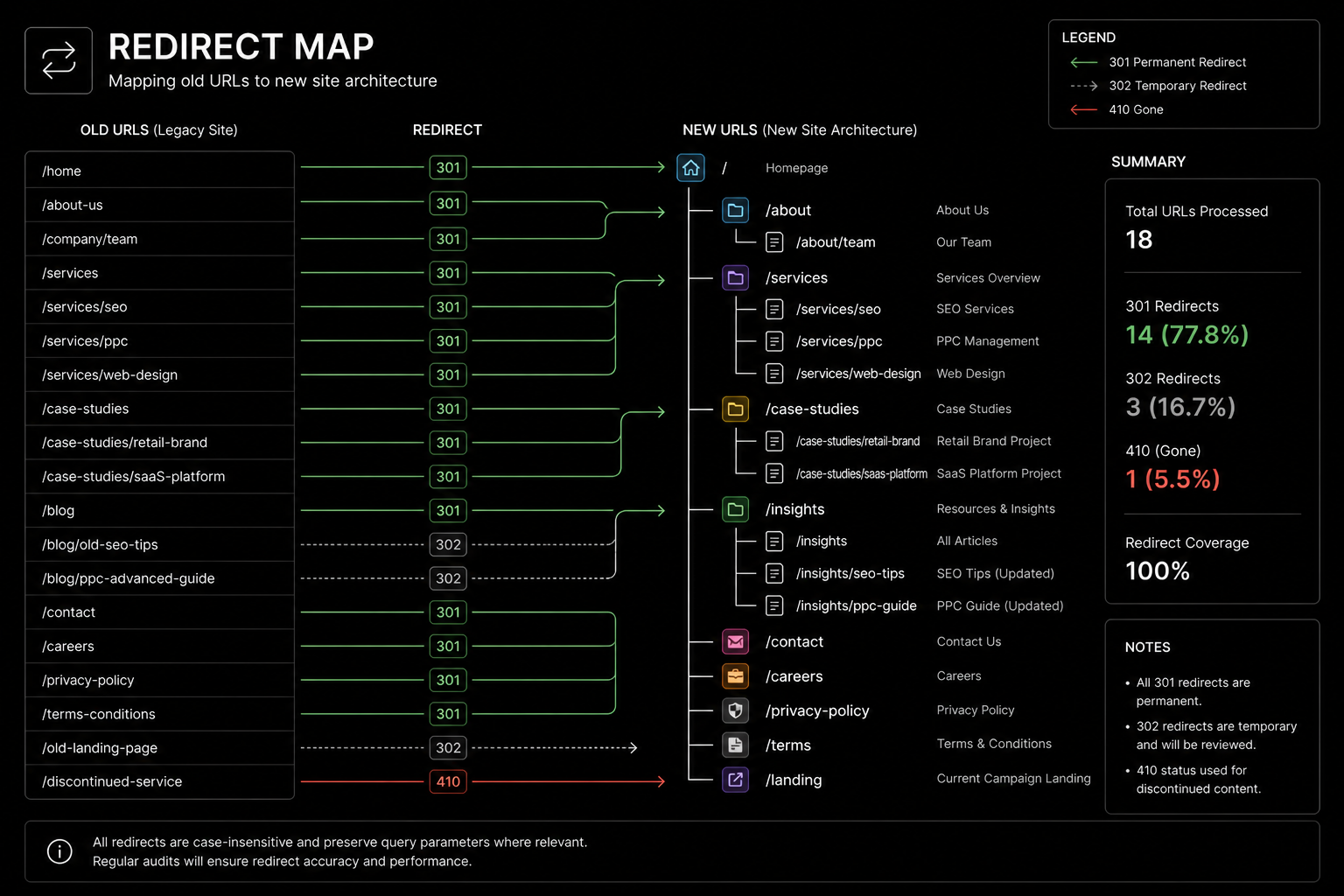
3. Build redirect plan early

Map legacy URLs and preserve authority-critical routes.

4. QA conversion journeys

Test forms, events, and CRM integrations before launch.

5. Run 90-day monitoring

Track rankings and lead quality weekly after release.Mid-article CTA -> Need support applying this to your stack? B2B redesign call and get a scoped roadmap with timeline, owners, and KPI targets.

Redirect map

Tools, References, and Benchmarks

  • 41-point redesign checklist
  • Redirect map workbook
  • Post-launch KPI dashboard
  • Semantic keyword targets to distribute naturally: b2b website redesign checklist, saas website redesign, b2b website refresh

Use these references during planning and QA: Google site migration guide, web.dev Core Web Vitals guidance, and Screaming Frog documentation.

Common Mistakes That Kill Performance

  • Treating redesign as brand-only work
  • Late redirect planning
  • No post-launch accountability

FAQ - B2B Website Redesign Checklist

How long does a b2b website redesign project usually take?

Most teams can ship an initial version in 4 to 8 weeks, then improve outcomes over one quarter with a weekly optimization cadence.

Is b2b website redesign relevant for UK and US teams?

Yes. The core framework is consistent across both markets. Differences are usually compliance details, buying behavior, and GBP/USD planning.

What should we measure first for b2b website redesign?

Track one leading metric, one conversion metric, and one revenue metric so execution stays tied to business impact.

Should we run this in-house or with a specialist partner?

If your team has deep expertise and bandwidth, in-house can work. If speed and risk control matter, working with a specialist partner is usually faster.

What is the most common failure mode?

Teams skip governance after launch. Data quality drifts, process quality declines, and performance plateaus. A simple weekly operating rhythm prevents this.

Conclusion

B2B Website Redesign Checklist performs best when execution decisions are tied to measurable outcomes from day one. Use this playbook to prioritize what matters, reduce risk, and create a repeatable optimization rhythm.Want a specialist team to accelerate delivery? Talk to B2B redesign specialists or book a consultation and we will map a practical rollout plan.Download the B2B Redesign Pipeline Protection Checklist to implement this framework with templates and checklists.

B2B Redesign Pipeline Protection Checklist — A complete redesign toolkit with a 41-point launch checklist, SEO migration plan, redirect workbook, QA templates, KPI dashboards, and post-launch monitoring framework to protect traffic, leads, and pipeline.

Website Redesign Cost: The Complete 2026 Breakdown
Website Redesign

Website Redesign Cost: The Complete 2026 Breakdown

Website redesign quotes for the same project can range 5x in price. £20k on one proposal, £100k on another for an identical brief. That variance isn't random. This guide breaks down what drives website redesign cost in 2026 — strategy vs execution costs, SEO vs conversion prioritisation, platform choice, and realistic budgets by business size.

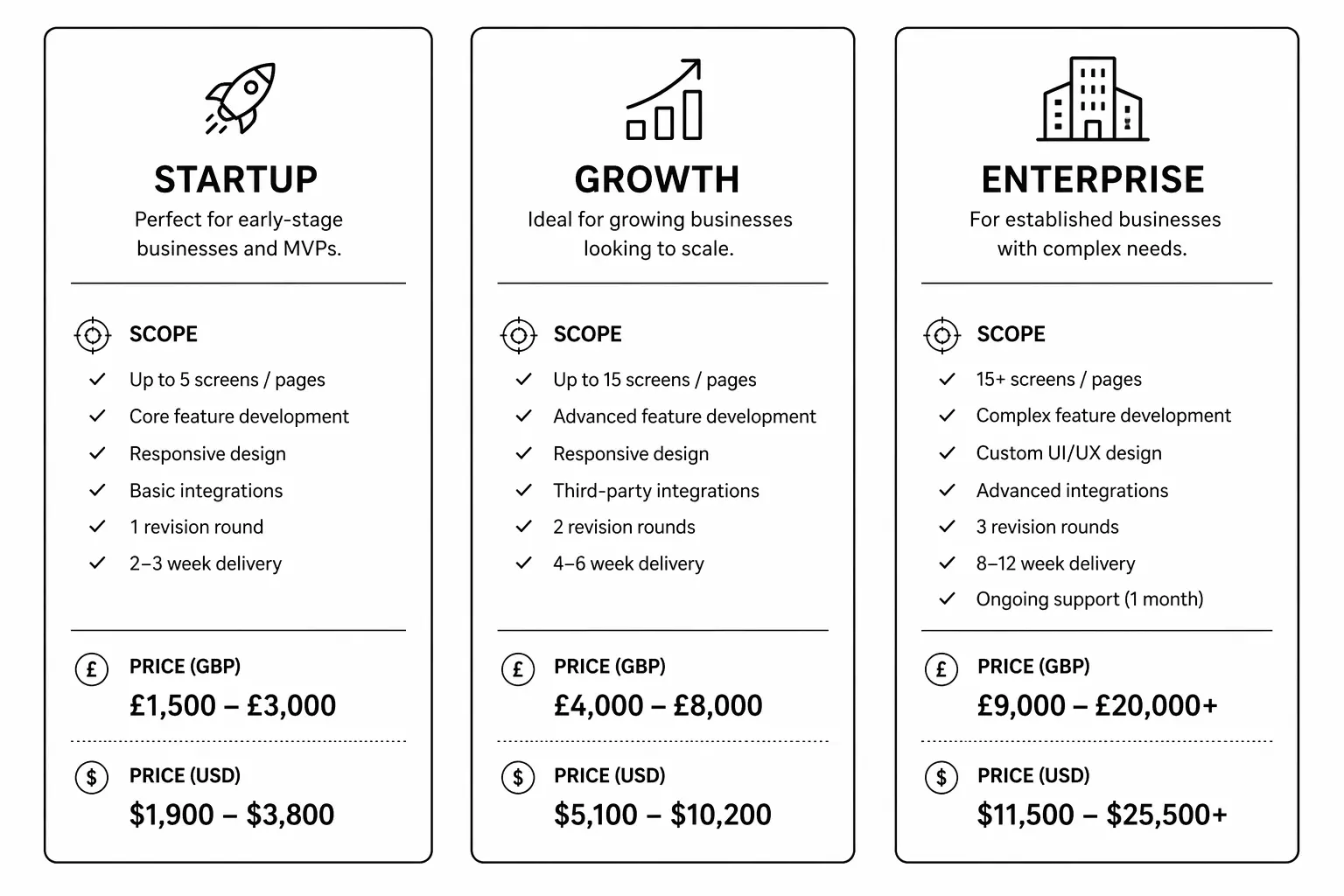
Website Redesign Cost by Business Stage

Startup / Pre-Product (5–10 pages):

  • UK: £8,000–18,000
  • USA: $10,000–25,000
  • Timeline: 6–10 weeks
  • Includes: Strategy, design, build, basic CMS, analytics setup, launch.

Growth-Stage B2B / SaaS (15–30 pages):

  • UK: £20,000–50,000
  • USA: $25,000–65,000
  • Timeline: 10–16 weeks
  • Includes: Full strategy + positioning, design system, CMS architecture, CRO roadmap, analytics instrumentation, launch + monitoring.

Scale-Stage or B2B Complex (25–50 pages, migrations):

  • UK: £40,000–100,000
  • USA: $50,000–130,000
  • Timeline: 14–24 weeks
  • Includes: Full audit, repositioning, multi-team discovery, content migration, SEO-safe redirect strategy, advanced integrations, training, post-launch CRO program.

Enterprise (50+ pages, multi-regional, high integration):

  • UK: £80,000–300,000+
  • USA: $100,000–400,000+
  • Timeline: 20–32 weeks
  • Includes: Full strategy, multiple design systems, content audit + migration, advanced CRM/tech stack integration, international SEO, white-glove support.

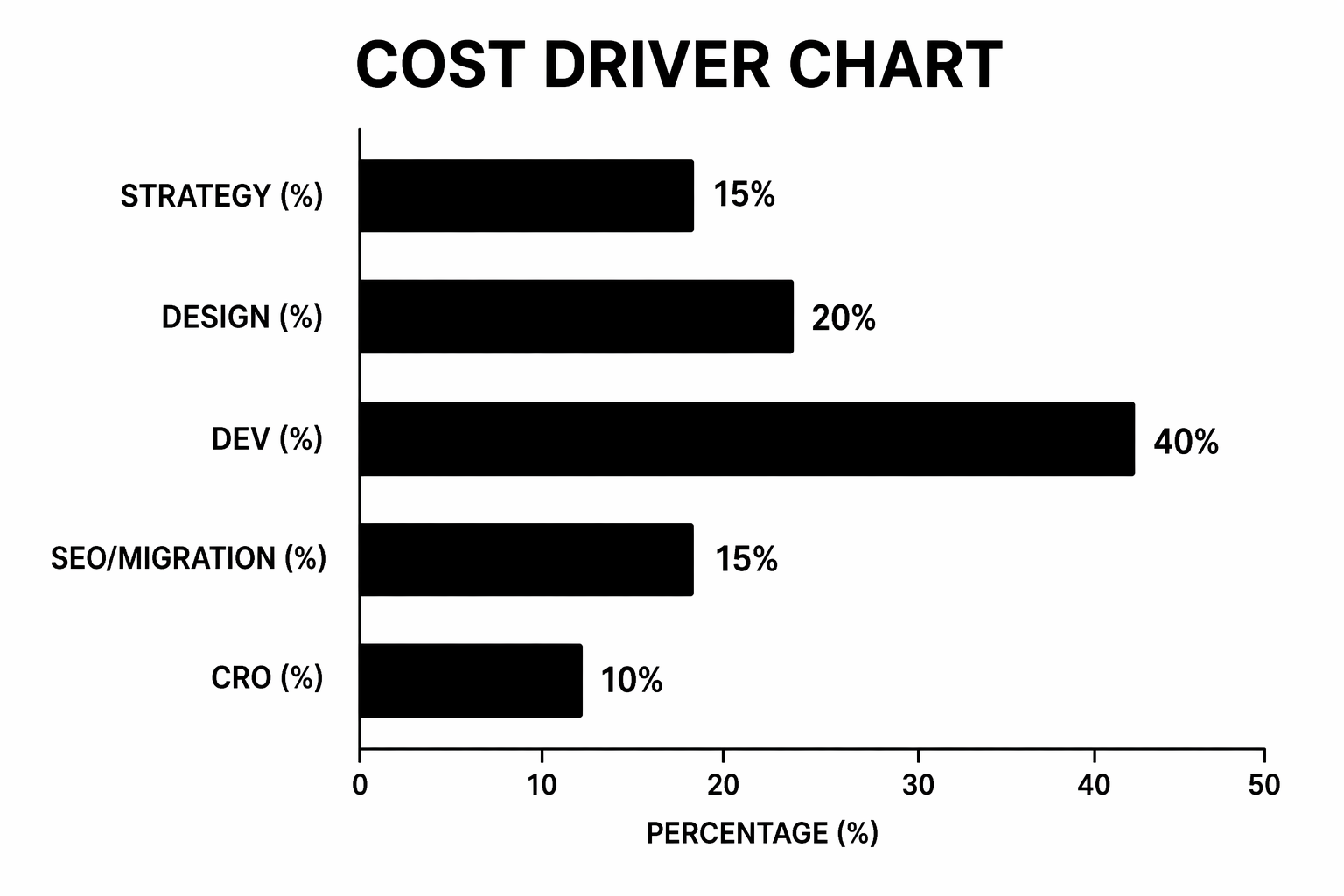
What Actually Drives Cost

Cost multipliers (add 20–50%):

  • Content migration from old site (100+ pages).
  • SEO-safe migration with 301 redirect strategy.
  • Platform change (WordPress → Webflow, etc.).
  • Repositioning or messaging strategy (adds discovery phase).
  • Complex CRM/tech integrations.
  • Multi-regional or multi-language variants.
  • Custom CRO program post-launch.

Cost reducers (subtract 20–40%):

  • Design already complete (just building).
  • No platform migration (same CMS).
  • Limited integrations (forms + analytics only).
  • Pre-aligned messaging (no repositioning needed).
  • Smaller scope (under 15 pages).

Fixed-Price vs Time-and-Materials

Fixed-price (best when): Scope is locked, timeline is predictable, changes are defined upfront. Protection for both parties, but quoter needs buffer for unknowns.Time-and-materials (best when): Scope is open, discovery is ongoing, or complexity is uncertain. Flexibility, but budget risk on your side. Always cap with a total ceiling.Hybrid (best for real projects): Fixed discovery phase + T&M build phase with capped hours. Balances clarity and flexibility.

Cost Driver Chart

Post-Launch Costs Often Overlooked

  • Retainer support: £500–2,000/month for ongoing updates and monitoring.
  • CRO program: £2,000–8,000/month for structured conversion testing (often more valuable than the initial redesign).
  • Content updates: £1,000–5,000/month for active publishing and refresh cycles.
  • Performance monitoring: Included in retainers or £200–500/month separately.

Total cost of ownership over 24 months: redesign cost + 12–24 months of retainers = often 2–3x the initial redesign budget.

Budgeting a redesign and need to pressure-test estimates? Our redesign specialists review proposals and map realistic costs before you commit. Book a pricing review.

Negotiating Better Rates

  • Lock scope early. Scope creep adds 30–50% to final cost. Define what's in, what's out, and what costs extra upfront.
  • Bundle design + build with one agency. Two separate vendors (designer + developer) adds coordination overhead.
  • Bundled retainer can reduce rates. "£40k project + £3k/month retainer for 12 months" might be quoted lower than separate engagements.
  • Longer commitment = lower rates. 12-month retainer usually costs 15–20% less per month than month-to-month.

FAQ

Why do redesign quotes vary so much?

Platform choice, scope complexity, agency location/tier, approach (template vs custom), post-launch support. All of these swing price 2–3x.

Is a cheap redesign ever a good idea?

No. Redesigns that are "cheap" usually cut SEO, CRO planning, or post-launch support. You end up with a beautiful site that loses traffic or doesn't convert. Spend appropriately.

Should I include CRO in the redesign budget?

Yes. Post-launch CRO usually returns 2–3x the initial redesign investment. Don't treat redesign and CRO as separate projects.

What's included in a retainer post-launch?

Usually: hosting monitoring, plugin/tool updates, bug fixes, minor content changes. Define upfront: what's included, what's billed hourly, what's out of scope.

Can I DIY a redesign on Webflow or WordPress?

If you have design and technical skills, yes for a small site. For anything client-facing or conversion-focused, the time cost usually outweighs budget savings.

Conclusion: Budget Based on Scope, Not Platform

Website redesign cost is determined by what you're actually redesigning (strategy, content, positioning, technical migration) — not the platform itself. Two teams on Webflow can price 5x apart based on scope and approach.Use this breakdown to evaluate proposals and negotiate confidently. The right cost is the cost that matches your actual scope and includes post-launch support.Need help scoping a redesign before you pitch? Our redesign team maps realistic budgets and timelines. Book a discovery call.

 The Redesign Budget Planner — a practical worksheet to estimate costs by scope, platform, and timeline.