


Inbound Logo
Web Development
Resources
Free audit
Free HubSpot Portal Audit
Get an instant audit of your HubSpot portal with actionable insights to improve CRM setup, automation, marketing, and overall performance.
Start Free Audit
button arrowbutton arrow
hubspot

HubSpot No.1 Powerful CRM : All You Need To Know About HubSpot

time
12 MIN
date
December 31, 2022
HubSpot No.1 Powerful CRM : All You Need To Know About HubSpot
In this article

What is HubSpot?

what is hubspot

HubSpot is a marketing and sales software company that helps businesses to grow their online presence and increase leads and sales. The company offers a suite of tools including a blog, website, and email platform that help businesses attract and engage customers. HubSpot offers a suite of tools for marketing, sales, and customer service, and, as well as a free CRM tool that sales teams can use to track and manage customers.

What services does HubSpot offer?

HubSpot is a company that provides a platform for inbound marketing and sales. The company offers a number of services, including HubSpot Sales, HubSpot Service Hub, HubSpot Marketing, and HubSpot CMS. HubSpot Sales is a sales automation tool that helps businesses close more deals and get more leads. HubSpot Service Hub is a customer service tool that helps businesses provide better customer service. HubSpot Marketing is a marketing automation tool that helps businesses attract more visitors, convert more leads, and close more customers.Hubspot is a leading software platform for inbound marketing and sales. They offer a suite of tools to help businesses grow their website traffic, convert more leads, and close more sales.Some of the services HubSpot offers include:

  • A powerful website platform that includes everything you need to design, build, and grow a website that drives results.
  • Lead capture and email marketing tools to help you turn more website visitors into leads and customers.
  • A CRM (customer relationship management) software to help you track and nurture your leads and customers through the buyer's journey.
  • A sales software to help you close more deals and grow your revenue.

HubSpot is a company that offers a variety of services related to inbound marketing and sales. These services include tools for website design, SEO, email marketing, social media, and more. HubSpot also offers to consult and training services to help businesses grow their online presence and sales.To learn more about HubSpot and the services we offer, Contact US today.[blogcta]

What are the benefits of using HubSpot?

benefits of using HubSpot

If you're looking for a comprehensive marketing and sales platform, HubSpot is a great option. Here are some of the benefits of using HubSpot:

  • HubSpot offers a wide range of features, making it a one-stop shop for all your marketing and sales needs.
  • HubSpot's services are designed to be used together, so you can get the most out of the platform.
  • HubSpot is constantly innovating and adding new features, so you can be sure that you're always up-to-date with the latest tools and technologies.
  • HubSpot offers great customer support, so you can always get help when you need it.

If you're looking for a comprehensive marketing and sales platform, HubSpot is a great option. With HubSpot, you can get the most out of the platform by using all the features together. HubSpot is constantly innovating, so you can be sure that you're always up-to-date with the latest tools and technologies. And if you need help, HubSpot's customer support is always there for you.There are plenty of benefits to using HubSpot, which is why it’s become such a popular CRM (customer relationship management) tool. For starters, HubSpot offers users a free CRM. That’s right – free. And it’s not a trial, either. You can use the HubSpot CRM forever for free, as long as you have up to 1,000 contacts. This alone is a huge selling point, as most CRMs (including Salesforce) charge monthly fees.HubSpot’s CRM is also incredibly user-friendly. It’s designed to be intuitive and easy to use, so you don’t need to waste time training your team on how to use it.Another big benefit of HubSpot is that it integrates with all of your other software. This is a huge time-saver, as you can avoid the hassle of manually transferring data between different platforms.Additionally, HubSpot offers a wealth of resources to help you get the most out of the platform. They have an extensive knowledge base, webinars, and even 1-on-1 coaching sessions. So, if you ever have a question or need help with something, you can be sure that HubSpot has you covered.Overall, there are plenty of reasons to love HubSpot. If you’re looking for a CRM that is free, user-friendly, and packed with features, then HubSpot is definitely worth checking out.

Benefits of using HubSpot:-

There's no doubt that HubSpot is one of the most popular inbound marketing platforms. And for a good reason: HubSpot offers a comprehensive suite of tools that can help businesses attract, engage, and delight customers.But what are the specific benefits of using HubSpot? Let's take a look:

  1. Comprehensive tools and features.
  2. As we mentioned, one of the main benefits of using HubSpot is the comprehensive nature of the platform. HubSpot offers everything you need to execute an inbound marketing strategy, from website and blog tools to CRM and sales features. This means you can manage your entire inbound marketing funnel from one platform, saving you a lot of time and energy.
  3. Ease of use.
  4. Another big benefit of HubSpot is that it's relatively easy to use, especially compared to other marketing platforms. While some features may take a little time to master, the overall platform is designed to be user-friendly and intuitive. This makes it a great choice for businesses that don't have a lot of time or resources to invest in learning a complicated marketing platform.
  5. Support and resources.
  6. In addition to being user-friendly, HubSpot also offers a lot of support and resources to help users get the most out of the platform. From detailed how-to guides to live training and support, HubSpot makes it easy to find the help you need when you need it.
  7. Flexibility and customization.
  8. Another big benefit of HubSpot is its flexibility and customization options. HubSpot offers a wide range of features, but you can also tailor the platform to fit your specific needs and goals.

There's no doubt that HubSpot is one of the most popular inbound marketing platforms. And for a good reason: HubSpot offers a comprehensive suite of tools that can help businesses attract, engage, and delight customers.[blogcta]

How can a HubSpot development agency help you?

As a business owner, you know that in order to stay competitive, you need to keep up with the latest technology and trends. That's where a HubSpot development agency can help.A HubSpot development agency can help you create a website that is optimized for inbound marketing. This means that your website will be designed to attract visitors and convert them into leads.In addition, a HubSpot development agency can help you with other aspects of inbound marketing, such as creating landing pages, creating email campaigns, and managing your social media accounts.If you're looking to take your business to the next level, then working with a HubSpot development agency is a smart choice.As your business grows, you may find that you need more help than you can provide internally. That's where a HubSpot development agency like Inbound Web Hub can come in. We specialize in HubSpot development and can provide a range of services to help you get the most out of the platform.Some of the ways we can help include:

  • Building custom HubSpot modules and integrations
  • Developing custom HubSpot templates
  • Optimizing your HubSpot account for maximum performance

If you're looking for help getting the most out of HubSpot, contact Inbound Web Hub today. We would be happy to discuss your needs and see how we can help.

How to get started with HubSpot.

If you're looking to get started with HubSpot, there are a few things you need to know. HubSpot is a powerful inbound marketing and sales platform that can help you attract more visitors, convert more leads, and close more customers. But it can be a bit overwhelming at first.Here's a quick overview of what you need to know to get started with HubSpot:

  1. HubSpot is made up of several different services, including a website builder, blog, email marketing, and CRM.
  2. You can use HubSpot to power your entire inbound marketing and sales process, or just one or two pieces of it.
  3. HubSpot is easy to use, but it's also very customizable. You can use the platform to build exactly the kind of marketing and sales process that fits your business.
  4. HubSpot offers a free trial, so you can try it out before you go to buy a paid plan.

If you're ready to get started with HubSpot, the first thing you need to do is sign up for a free trial. Then, you can start exploring the platform and using it to power your marketing and sales process.Are you looking to get started with HubSpot? HubSpot is a powerful inbound marketing and sales platform that can help your business grow. But where do you start?InboundWebHub is a HubSpot Certified Development Agency. We can help you get the most out of HubSpot and achieve your business goals.Here are a few ways we can help you get started with HubSpot:

  1. Onboarding & Implementation
  2. The first step is to get onboarded and set up with HubSpot. Our team can help you with this, ensuring that you are using the platform to its fullest potential.
  3. Strategy & Consulting
  4. Not sure how to use HubSpot to achieve your goals? Our team can help you develop a strategy and plan that will get you results.
  5. Custom Development
  6. If you need custom development work done on HubSpot, our team can help. We have experience building custom HubSpot applications.
  7. Training & Support
  8. Not sure how to use HubSpot? Our team can provide training and support to help you get the most out of the platform.
KEEP BUILDING
title arrow

You've got the plan. Let's build it.

We turn the frameworks you just read into the flows, pages, and automation behind them — under your brand, always.

Keep reading

View all articles
button arrowbutton arrow
HubSpot Custom Modules and Themes: A Developer Deep Dive
hubspot

HubSpot Custom Modules and Themes: A Developer Deep Dive

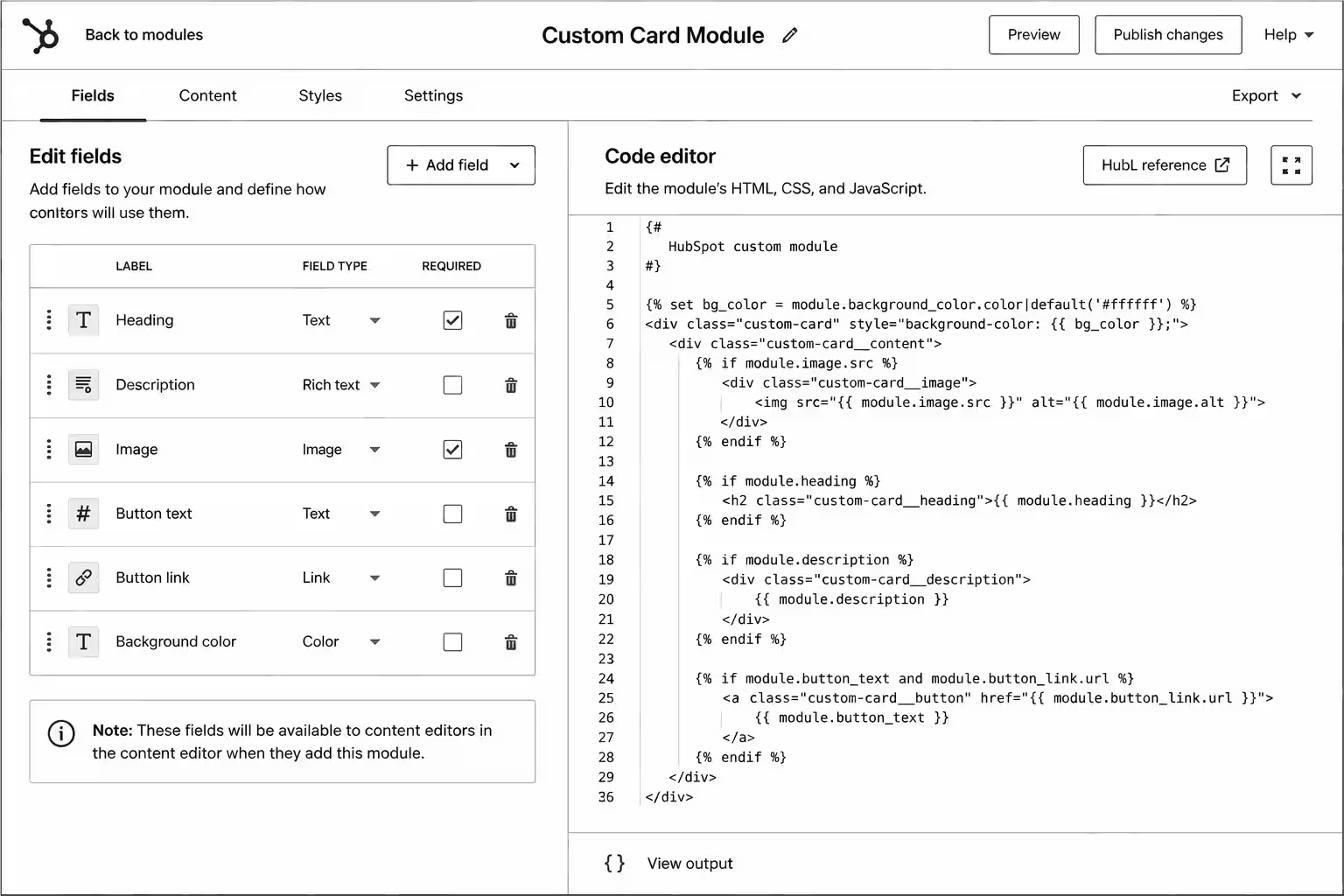
HubSpot Custom Modules and Themes in 2026 is won by execution quality, not platform hype. Teams that perform consistently align strategy, implementation, and measurement into one operating system. This guide gives the practical framework, internal link map, and optimization cadence to do that.HubSpot's drag-and-drop power lives in custom modules. Here's the developer-grade approach the best CMS sites use. If you want implementation help, work with HubSpot CMS team. For connected strategy, also review Hubspot Website Design Playbook and Hubspot Development Agency.

What HubSpot Custom Modules and Themes Means in Practice

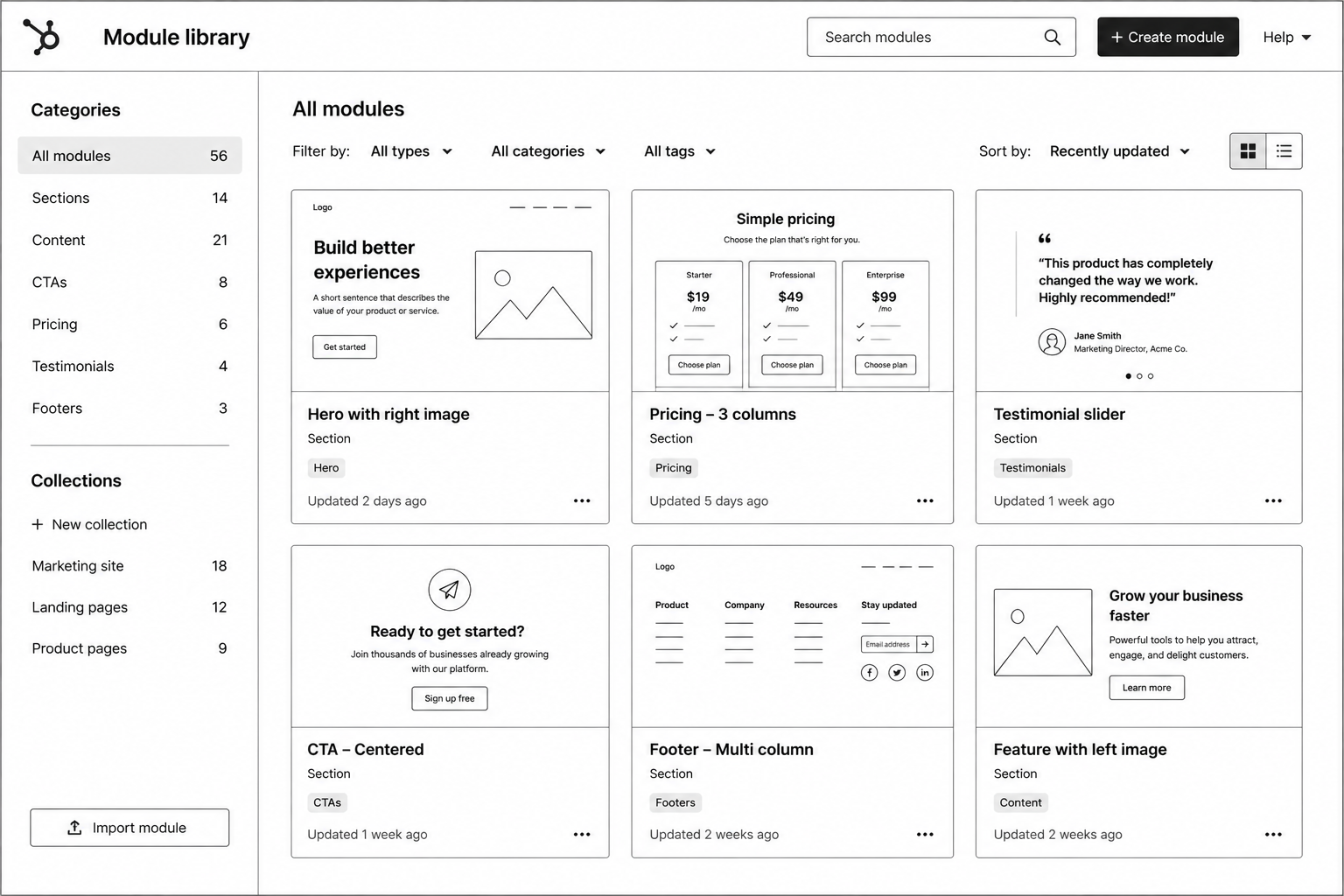
HubSpot custom modules are reusable building blocks that let marketing teams ship fast without breaking design systems. In 2026, module strategy is a conversion and governance decision, not just a developer preference.

Why hubspot custom modules Matters in 2026

1. High-velocity teams need modular systems, not one-off page builds.2. HubL and theme structure directly influence performance and editor reliability.3. Reusable modules reduce QA overhead because patterns are tested once and reused.

Step-by-Step Playbook

1. Design module taxonomy

Define global, section, and page-level modules before coding.

2. Set strict field rules

Use defaults, naming standards, and validation for editor safety.

3. Sync design tokens

Align typography, spacing, and colors into reusable standards.

4. Add performance guardrails

Keep module JS lean and optimize media loading.

5. Publish editor playbook

Document how and when each module should be used.Mid-article CTA -> Need support applying this to your stack? HubSpot dev consultation and get a scoped roadmap with timeline, owners, and KPI targets.

Module library

Tools, References, and Benchmarks

  • HubSpot CLI workflow
  • Module naming standard
  • Editor QA checklist
  • Semantic keyword targets to distribute naturally: hubspot theme development, hubspot custom module tutorial, hubspot hubl

Use these references during planning and QA: HubSpot Knowledge Base, HubSpot developer docs, and Salesforce product documentation.

Common Mistakes That Kill Performance

  • Building near-duplicate modules
  • Ambiguous field labels
  • No module governance for future editors

FAQ - HubSpot Custom Modules and Themes

How long does a hubspot custom modules project usually take?

Most teams can ship an initial version in 4 to 8 weeks, then improve outcomes over one quarter with a weekly optimization cadence.

Is hubspot custom modules relevant for UK and US teams?

Yes. The core framework is consistent across both markets. Differences are usually compliance details, buying behavior, and GBP/USD planning.

What should we measure first for hubspot custom modules?

Track one leading metric, one conversion metric, and one revenue metric so execution stays tied to business impact.

Should we run this in-house or with a specialist partner?

If your team has deep expertise and bandwidth, in-house can work. If speed and risk control matter, working with a specialist partner is usually faster.

What is the most common failure mode?

Teams skip governance after launch. Data quality drifts, process quality declines, and performance plateaus. A simple weekly operating rhythm prevents this.

Conclusion

HubSpot Custom Modules and Themes performs best when execution decisions are tied to measurable outcomes from day one. Use this playbook to prioritize what matters, reduce risk, and create a repeatable optimization rhythm.Want a specialist team to accelerate delivery? Talk to HubSpot CMS team or book a consultation and we will map a practical rollout plan.Download the HubSpot Custom Module Starter Kit to implement this framework with templates and checklists.

HubSpot Custom Development Toolkit — module requirements document, HubSpot theme architecture guide, reusable component planner, developer handoff template, QA framework, and optimization checklist to create scalable HubSpot CMS experiences.

HubSpot vs Salesforce: Honest 2026 Comparison for Growing Teams
hubspot

HubSpot vs Salesforce: Honest 2026 Comparison for Growing Teams

HubSpot vs Salesforce: Honest 2026 Comparison for Growing Teams

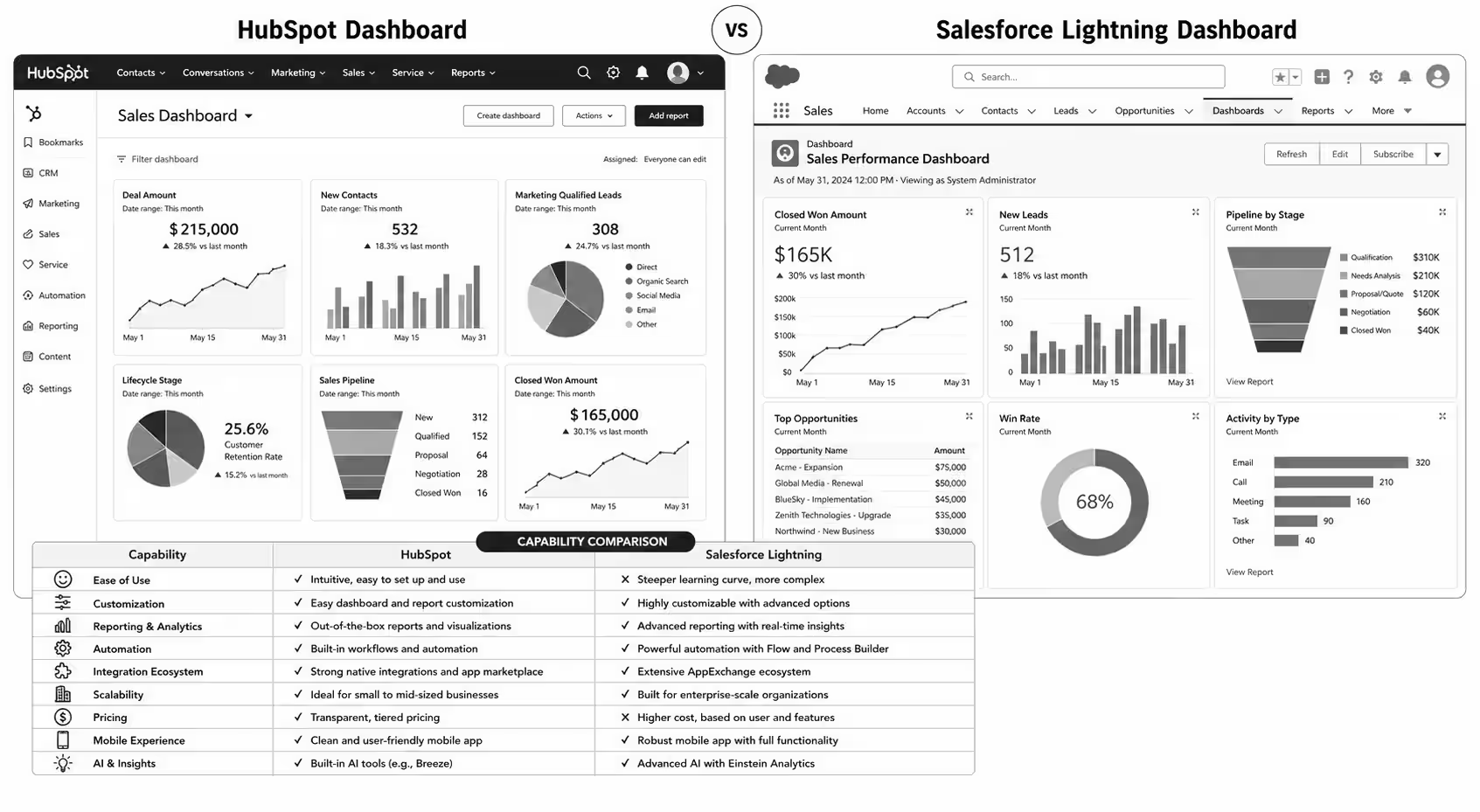
HubSpot vs Salesforce in 2026 is won by execution quality, not platform hype. Teams that perform consistently align strategy, implementation, and measurement into one operating system. This guide gives the practical framework, internal link map, and optimization cadence to do that.HubSpot vs Salesforce isn't decided by feature lists anymore. Here's how to choose based on your actual stage. If you want implementation help, work with HubSpot development services. For connected strategy, also review Hubspot CRM Implementation and Hubspot Website Design Playbook.

What HubSpot vs Salesforce Means in Practice

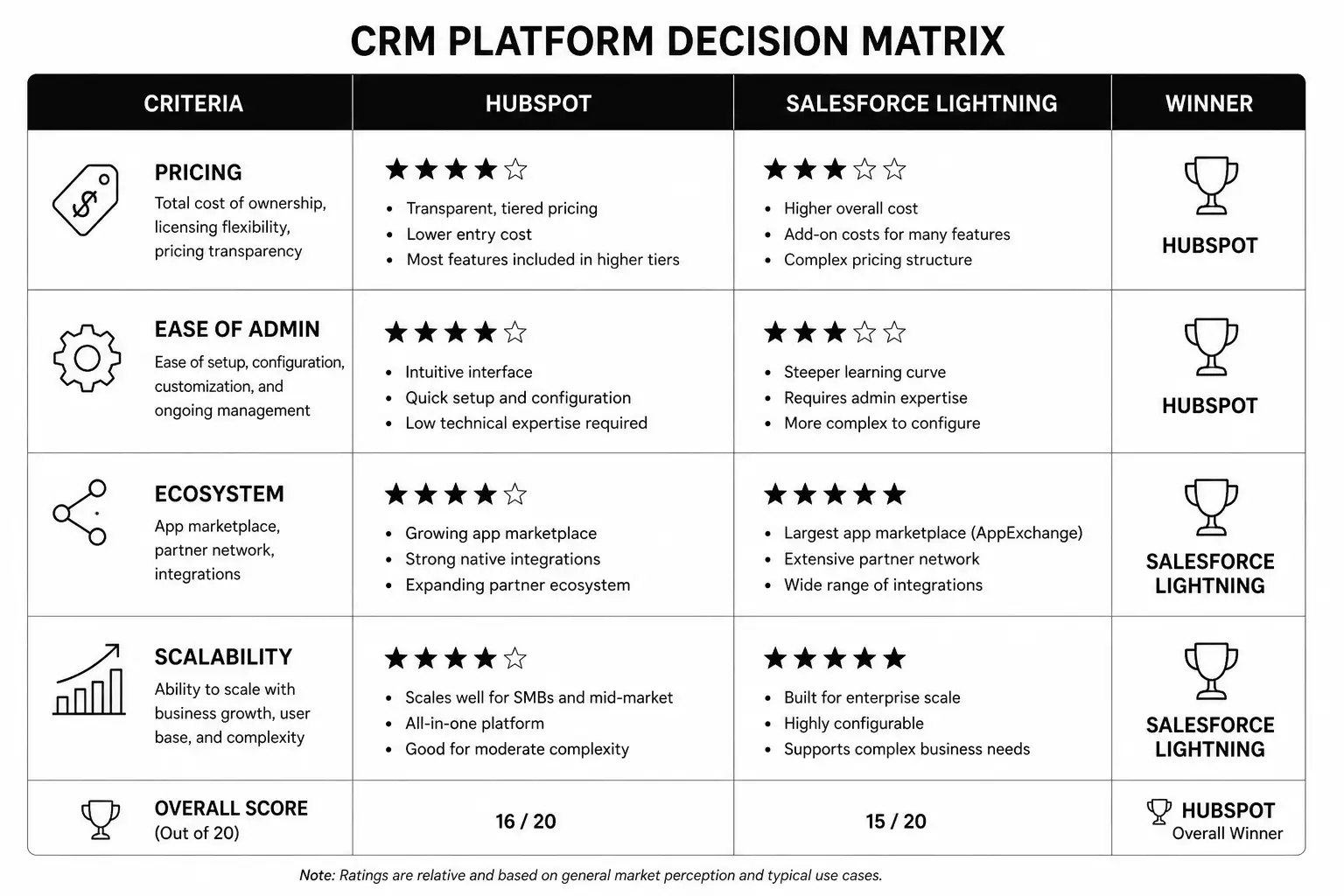
HubSpot vs Salesforce is a fit decision, not a feature checklist. HubSpot usually wins on speed and lower admin overhead; Salesforce usually wins when you need highly custom objects and enterprise governance from day one.

Why hubspot vs salesforce Matters in 2026

1. Total cost is often misjudged when teams compare list price but ignore admin and integration load.2. AI assistants now exist in both platforms, so data model quality matters more than logos.3. RevOps teams are measured on forecast quality, so CRM fit now affects board-level reporting.

Step-by-Step Playbook

1. Map GTM complexity

Score pipeline complexity, product lines, territories, and approval layers.

2. Model 3-year cost

Include licenses, admin headcount, consultant support, and migration cost.

3. Validate live workflows

Test lead routing and renewals in sandbox before committing.

4. Score reporting fit

Confirm dashboards can be built without spreadsheet patchwork.

5. Choose with weighted criteria

Use a scorecard so internal politics do not override evidence.Mid-article CTA -> Need support applying this to your stack? HubSpot vs Salesforce advice and get a scoped roadmap with timeline, owners, and KPI targets.

Tools, References, and Benchmarks

  • CRM weighted scorecard
  • TCO calculator (GBP and USD)
  • Sandbox evaluation checklist
  • Semantic keyword targets to distribute naturally: hubspot or salesforce, hubspot vs salesforce pricing, salesforce alternative

Use these references during planning and QA: HubSpot Knowledge Base, HubSpot developer docs, and Salesforce product documentation.

Common Mistakes That Kill Performance

  • Choosing based on brand familiarity
  • Ignoring admin staffing needs
  • Skipping migration risk planning

FAQ - HubSpot vs Salesforce

How long does a hubspot vs salesforce project usually take?

Most teams can ship an initial version in 4 to 8 weeks, then improve outcomes over one quarter with a weekly optimization cadence.

Is hubspot vs salesforce relevant for UK and US teams?

Yes. The core framework is consistent across both markets. Differences are usually compliance details, buying behavior, and GBP/USD planning.

What should we measure first for hubspot vs salesforce?

Track one leading metric, one conversion metric, and one revenue metric so execution stays tied to business impact.

Should we run this in-house or with a specialist partner?

If your team has deep expertise and bandwidth, in-house can work. If speed and risk control matter, working with a specialist partner is usually faster.

What is the most common failure mode?

Teams skip governance after launch. Data quality drifts, process quality declines, and performance plateaus. A simple weekly operating rhythm prevents this.

Conclusion

HubSpot vs Salesforce performs best when execution decisions are tied to measurable outcomes from day one. Use this playbook to prioritize what matters, reduce risk, and create a repeatable optimization rhythm.Want a specialist team to accelerate delivery? Talk to HubSpot development services or book a consultation and we will map a practical rollout plan.Download the CRM Selection Scorecard to implement this framework with templates and checklists.

HubSpot vs Salesforce Comparison Toolkit — CRM feature scorecard, business requirements worksheet, cost calculator, automation comparison guide, reporting checklist, and implementation roadmap to confidently select the best CRM for your business.

HubSpot CRM Implementation Guide: 90-Day Rollout for B2B Companies
hubspot

HubSpot CRM Implementation Guide: 90-Day Rollout for B2B Companies

HubSpot CRM Implementation Guide: 90-Day Rollout for B2B Companies

HubSpot is the easy CRM to start using and one of the harder CRMs to implement well. The product is designed to be turn-key — and that's precisely why most rollouts stall. Teams import a contact list, configure a couple of pipelines, and call it live. Six months later, sales is back in spreadsheets and marketing has lost track of which leads are real.This HubSpot CRM implementation guide is the 90-day rollout plan our HubSpot development team runs for B2B companies between 10 and 250 employees. It covers data model, migration, automation, reporting, and the adoption playbook that decides whether the CRM lasts past month four.If you're still deciding between HubSpot and Salesforce, read the HubSpot vs Salesforce comparison first.

What HubSpot CRM Implementation Actually Means

Implementation is more than a setup checklist. A real HubSpot CRM implementation is a structured project that aligns four things: your data model, your sales process, your marketing automation, and your team's daily behaviour. Each one is solvable; the integration of all four is where most projects fail.A successful rollout produces:

  • A clean, deduplicated database with consistent property naming
  • Pipelines that match how your team actually sells
  • Automation that does the busywork without breaking edge cases
  • Reports that surface the metrics leadership actually checks
  • Adoption from sales, marketing, and CS without daily friction

Why HubSpot CRM Implementation Matters in 2026

Three forces make 2026 the year to do this properly.1. HubSpot's AI features only work on clean data. Breeze (HubSpot's AI suite) summarises deals, scores leads, and drafts outreach. Garbage data in, garbage AI out. The teams getting real value from Breeze in 2026 are the ones who fixed their data model first.2. RevOps is now a board-level conversation. Pipeline visibility, attribution, and forecast accuracy are CFO concerns. A messy CRM costs you in meetings, not just operations.3. Sales-led + product-led hybrids need real CRM rigor. If your B2B motion blends inbound, outbound, and product-qualified leads, your CRM needs to track all three cleanly — and most don't.

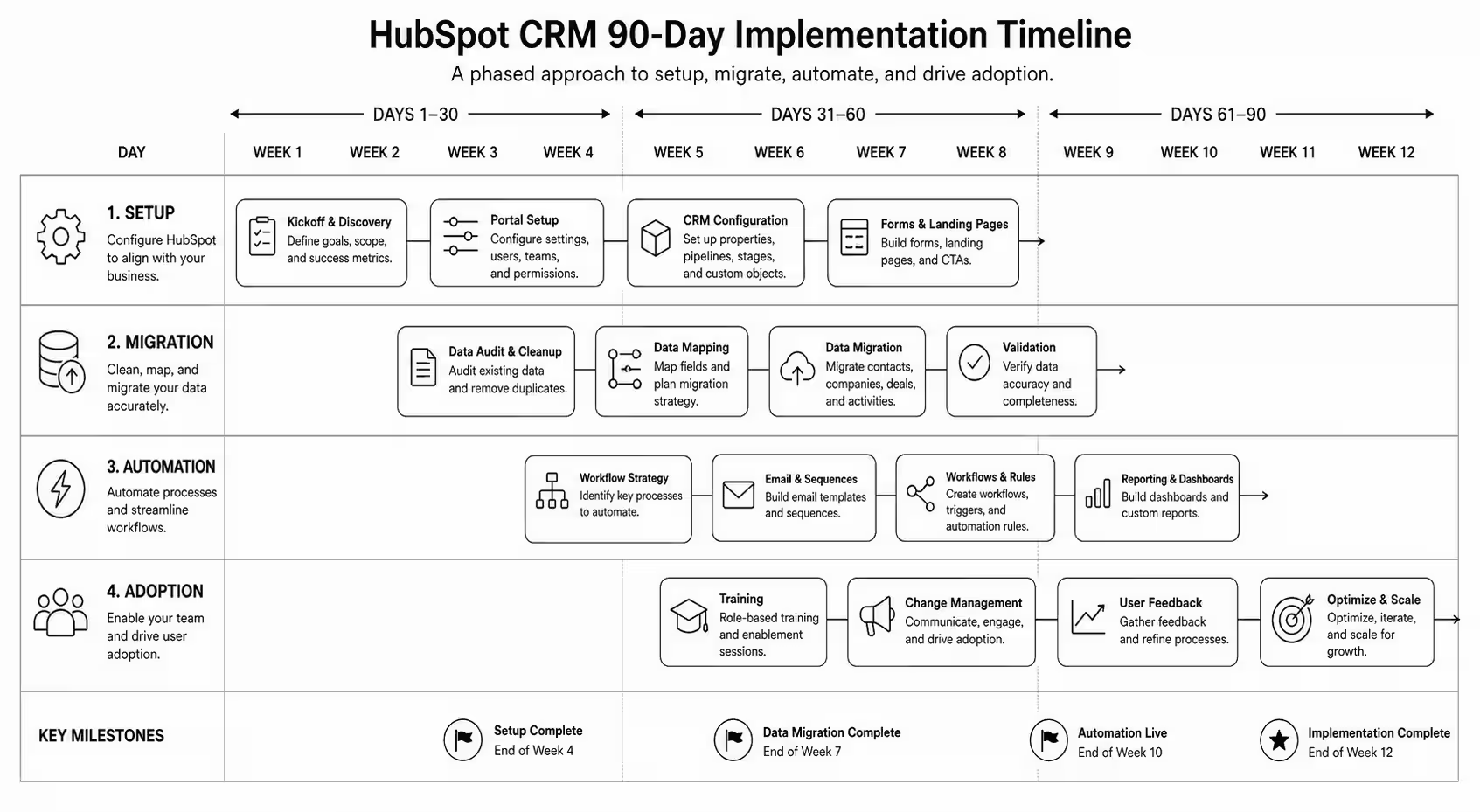
How a 90-Day HubSpot CRM Rollout Works

The rollout splits into three 30-day phases: foundation, automation, and adoption. Most failed rollouts skip phase one and rush to phase two — automating broken processes makes them worse, not better.

Days 1–30: Foundation

  • Stakeholder mapping. Identify the daily users (SDRs, AEs, marketing, CS) and the data consumers (leadership, finance).
  • Data model design. Define properties on Companies, Contacts, Deals, Tickets. Document property purpose, type, and ownership.
  • Pipeline architecture. Design pipelines and stages around your actual sales process — not HubSpot's defaults.
  • Lifecycle stages. Define what each stage means (Lead → MQL → SQL → Opportunity → Customer) and the criteria for transitions.
  • Migration plan. If migrating from another CRM, map fields, owners, and history. Plan deduplication.
  • User permissions. Set up teams, roles, and access. Default settings expose too much.

Days 31–60: Automation

  • Workflows for lifecycle transitions. Automatic stage updates based on behaviour, not just manual changes.
  • Lead routing. Round-robin, territory-based, or AE-of-the-month — whatever matches your model.
  • Lead scoring. Start simple (rules-based), graduate to predictive once you have data. See AI lead scoring guide.
  • Email sequences and templates. Library of approved outbound and follow-up templates per persona.
  • Task automation. Auto-create follow-up tasks at stage transitions; auto-create check-ins for stalled deals.
  • Integration setup. Connect tools that feed CRM data — calendar, email, calling, Slack, your CMS, your product analytics.

Days 61–90: Adoption

  • Training by role. SDRs, AEs, marketing, and CS each need different training. Generic onboarding fails.
  • Reporting and dashboards. Build the 5–8 dashboards leadership will actually check weekly. Cull the rest.
  • Daily standup integration. Make CRM the source of truth for the metrics discussed in standup.
  • Hygiene rituals. Weekly deal review, monthly data audit. Without these, the CRM degrades within 90 days.
  • Manager enablement. Sales managers must run reviews from HubSpot, not from spreadsheets. Otherwise reps never trust the system.
  • Iteration cadence. Quarterly review of properties, workflows, and reports. Prune, don't accumulate.

Mid-article CTA → Need a HubSpot specialist to run the 90 days for you? Book a HubSpot CRM rollout call and we'll scope the project in 30 minutes.

Step-by-Step: The Foundation Phase in Detail

1. Audit your current state

Before you touch HubSpot: document the existing process. What CRM (or spreadsheet) is being used? What pipelines exist? What reports run? Where does data leak?

2. Design the data model on paper

List every property your team needs on each object. Group them: identification (name, email), firmographic (company size, industry), behavioural (last visit, last email open), commercial (deal value, close date), operational (owner, source, status).

3. Set up the HubSpot account properly

  • Configure currency (multi-currency if you sell across UK/USA)
  • Set timezone, fiscal year
  • Create teams matching your org structure
  • Set up users with appropriate permissions
  • Configure the master Brand Kit (logo, colors) for templates

4. Create custom properties before importing data

If you import first and add properties later, you'll have inconsistent data. Property-first, then import.

5. Build pipelines and stages

For sales: typical 5–7 stages from Connected to Closed Won/Lost. For CS: separate pipeline for renewals and expansions. For support: ticket pipeline with priority and SLA.

6. Configure lifecycle stages and lead status

Define the criteria. Document them. Make them automatic where possible (workflows that move contacts from Lead to MQL based on score thresholds).

7. Migrate data with a clean import file

Dedupe, standardise (capitalisation, country codes, phone formats), map owners, validate emails. Import companies first, then contacts, then deals.

8. Validate

Spot-check 50 records across all object types. Confirm associations, property values, and ownership. Fix the data model before automating on top of it.

Hubspot adoption dashboard

Best Tools for HubSpot CRM Implementation

  • HubSpot Operations Hub — for data quality, sync, and custom-coded actions. Worth the upgrade for >100-employee implementations.
  • Insycle — bulk data cleansing and dedup. Saves weeks on migration projects.
  • HubSpot's Migration IQ — for Salesforce-to-HubSpot migrations specifically.
  • Reveal or Crossbeam — partner-data overlay. Rich for B2B account expansion.
  • Default Tasks app — for automated task creation at stage transitions.
  • Looker Studio + HubSpot connector — for cross-tool reporting (HubSpot + product + ad spend).

Common HubSpot Implementation Mistakes

  • Importing data before designing properties. The single most common failure mode. Inconsistent data is hard to clean later.
  • Copying competitor pipelines. Your sales process isn't theirs. Design for how your team actually sells.
  • Over-automating early. Rules nobody understands break in production. Start with manual processes, automate once you've seen the edge cases.
  • Skipping training. A perfect CRM with no adoption is worse than a clunky one used daily.
  • No data hygiene rituals. Without weekly hygiene, the CRM degrades quickly.
  • Treating Marketing Hub and Sales Hub as separate projects. They share data — implement them together.
  • Ignoring HubSpot AI from day one. Breeze is genuinely useful when configured early. See marketing AI guide.

FAQ — HubSpot CRM Implementation

How long does HubSpot CRM implementation take?

For B2B companies under 250 employees, 90 days is a realistic full rollout including foundation, automation, and adoption. Larger orgs or complex Salesforce migrations can take 6 months.

How much does HubSpot CRM implementation cost?

Platform costs vary by hub and seat count (typically $2k–$15k/mo for mid-market). Implementation services from a HubSpot partner agency typically run $15k–$80k depending on complexity. Worth pricing properly — bad implementations are expensive to redo.

Should I hire a HubSpot partner agency or do it in-house?

If RevOps is a permanent function in your org, hire in-house long-term but use a partner for the rollout. If RevOps is a one-time project, partner-led is cleaner. See the HubSpot agency selection guide.

Can I use HubSpot CRM for free?

Yes — HubSpot's free CRM is genuinely capable. The free tier holds for <50-person teams with simple pipelines. Past that, paid hubs unlock the automation and reporting needed for serious RevOps.

Does HubSpot replace Salesforce?

For most B2B companies under 500 employees, yes. Above that, the answer depends on data complexity, ecosystem dependencies, and admin overhead tolerance. See the HubSpot vs Salesforce comparison.

How do I get my sales team to actually use HubSpot?

Three levers: make it easier than the alternative (mobile + Gmail/Outlook integration), make manager reviews run from it, and tie compensation visibility to it. The first 60 days of behavioural reinforcement decide adoption.

Conclusion: Implementation Is Where HubSpot ROI Is Won or Lost

HubSpot is one of the best CRMs for B2B companies — but only if implementation is done with the same rigor you'd apply to any other system that runs your revenue operations. The 90-day plan above isn't aggressive; it's the realistic baseline for a rollout that sticks.Our HubSpot development team has run CRM implementations for B2B SaaS, professional services, and ecommerce brands across the UK and USA. Book a HubSpot rollout call and we'll scope your 90-day plan in 30 minutes.Download the HubSpot 90-Day Implementation Plan — the exact roadmap and checklist we run for clients.

HubSpot CRM 90-Day Implementation Blueprint — CRM audit checklist, implementation roadmap, pipeline configuration guide, workflow automation planner, team training checklist, and KPI dashboard to build a scalable HubSpot CRM system.